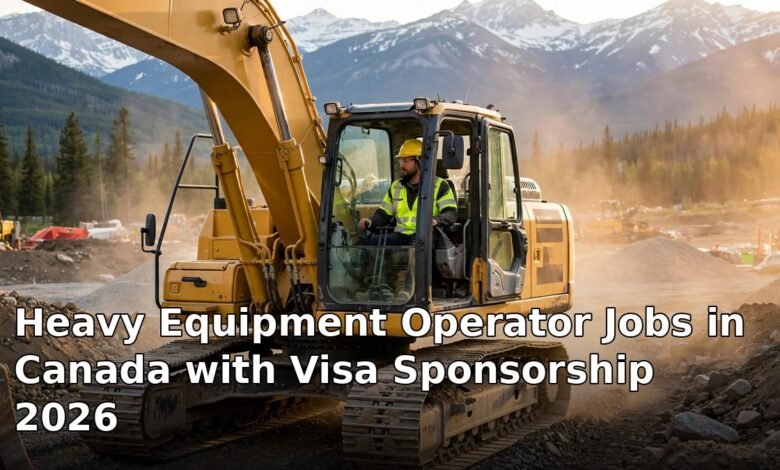
Heavy equipment operator jobs in Canada with visa sponsorship 2026 are a genuinely viable route for experienced operators: construction and mining employers in provinces like Alberta and Ontario regularly obtain LMIA approvals for bulldozer, excavator, loader and grader operators, with advertised pay running CAD $30–45 per hour for full-time permanent roles. A live example is a Calgary contractor currently hiring five heavy equipment operators at $30 an hour. This guide explains the LMIA and Temporary Foreign Worker Program route, what certification you actually need (it is voluntary in most provinces), which employers hire internationally, and how to apply.
New to the Canadian work-permit process? Read our Canada 2-year temporary work permit guide to understand how the LMIA, the job offer, and the work permit fit together.
What Heavy Equipment Operators Do in Canada
Heavy equipment operators run excavators, bulldozers, loaders, graders, backhoes and compactors on construction sites, road projects, mines and industrial sites. The Calgary posting used as this article’s benchmark (five vacancies, full-time, permanent) lists typical duties: operating heavy machinery, cleaning and lubricating equipment, refilling tanks, and even working with computer-controlled equipment — a reminder that modern operators are technicians, not just drivers. Shifts commonly include day, evening, weekend and overtime, so stamina and schedule flexibility matter as much as machine hours.
The LMIA Route: How Visa Sponsorship Actually Works
There is no general ‘heavy equipment operator visa’ — the route is the Temporary Foreign Worker Program (TFWP), where a Canadian employer first obtains a positive Labour Market Impact Assessment (LMIA) proving no qualified Canadian could fill the role, then the worker applies for an employer-specific work permit. LMIA approvals for heavy equipment operators are common in construction and mining because demand outruns domestic supply in boom regions. Under the 2025–2026 LMIA tightening, employers must now post the opening on the federal Job Bank with Direct Apply and genuinely consider domestic applicants — which also means the listings you find on Job Bank are increasingly the real operating employers, not hidden staffing fronts.
Operators starting out may also consider forklift operator jobs in Canada with visa sponsorship 2026, which share the same LMIA route at a lower experience bar.
See the wider picture in our guide to construction worker jobs in Canada with visa.
Mechanics can check diesel mechanic jobs in Canada — the trade that keeps the machines running.
If you also drive on-road, compare delivery driver jobs in Canada with visa sponsorship.
Certification and Experience Requirements
Here is the good news: in most Canadian provinces, heavy equipment operator is a voluntary-trade occupation, meaning no mandatory provincial certificate is required to work — employers set the bar themselves, typically 2+ years of verifiable machine time and a valid operator certificate or licence from your home country. Ontario lists it as a voluntary trade as well. International experience counts: the Calgary posting above welcomes experienced operators without demanding Canadian credentials. That said, certification (such as a Heavy Equipment Operator credential or trade school diploma) strengthens your LMIA application, because Service Canada wants evidence the foreign hire is genuinely skilled.
Pay, Hours and Where the Jobs Are
Advertised wages for sponsored heavy equipment operator roles run CAD $30–45 per hour for a 40-hour week, putting annual pay around $62,000–$94,000 before overtime — the $30/hr Calgary posting sits at the entry end of that band, and mining and northern-project roles pay the premium end. Demand clusters in Alberta (oil sands support, Calgary/Edmonton infrastructure), Ontario (GTA construction), and British Columbia. Roles are overwhelmingly full-time and permanent, since employers only invest in an LMIA for a lasting hire. Overtime, camp jobs in remote areas, and shift premiums can push total compensation well above the base rate.
How to Apply for Heavy Equipment Operator Jobs in Canada with Visa Sponsorship in 2026
Start on the Government of Canada Job Bank and filter for listings tagged ‘LMIA approved’ — those employers have already done the hard part. Prepare a Canadian-format resume (concise, machine types and hours stated up front, certifications listed), plus scanned proof of experience such as reference letters and certificates. Apply only through the employer’s stated channel and never pay anyone for an LMIA or a job offer — selling LMIAs is illegal and a leading source of scams targeting foreign operators. Once you hold an LMIA-backed job offer, the employer-specific work permit application follows; processing times vary by country, so apply as early in the construction season as possible.
Apply Now
Employer: V Contracting Inc – Calgary, AB (5 vacancies, $30/hr, permanent full-time)
Frequently Asked Questions
Can foreigners get heavy equipment operator jobs in Canada with sponsorship?
Yes. Employers in construction and mining regularly obtain LMIA approvals for experienced heavy equipment operators, which then support an employer-specific work permit under the Temporary Foreign Worker Program.
What certification do I need to operate heavy equipment in Canada?
In most provinces it is a voluntary trade — no mandatory provincial certificate. Employers typically require 2+ years of verifiable machine experience and a valid operator certificate or licence, with home-country credentials accepted.
How much do heavy equipment operators earn in Canada?
Sponsored roles advertise CAD $30–45 per hour for a 40-hour week, roughly $62,000–$94,000 a year before overtime, with mining and remote-project roles paying the higher end.
Where do I find LMIA-approved operator listings?
The Government of Canada Job Bank, filtered for LMIA-approved postings. Under current rules employers must post there with Direct Apply, so the listings increasingly come from the real operating employers.
Heavy equipment operator jobs in Canada with visa sponsorship 2026 rest on a proven, rules-based LMIA route: real demand in Alberta and Ontario, CAD $30–45 per hour pay, and no mandatory provincial licence in most provinces. Bring verifiable machine hours, target Job Bank listings already carrying LMIA approval, and treat any request for payment for a job or LMIA as a scam. Do that, and the pathway from machine cab at home to machine cab in Canada is straightforward.