Start with the route overview in our South Korean work visa for job seekers guide — it frames where the E-9 fits.
What Welders Do in South Korea (and What It Pays)
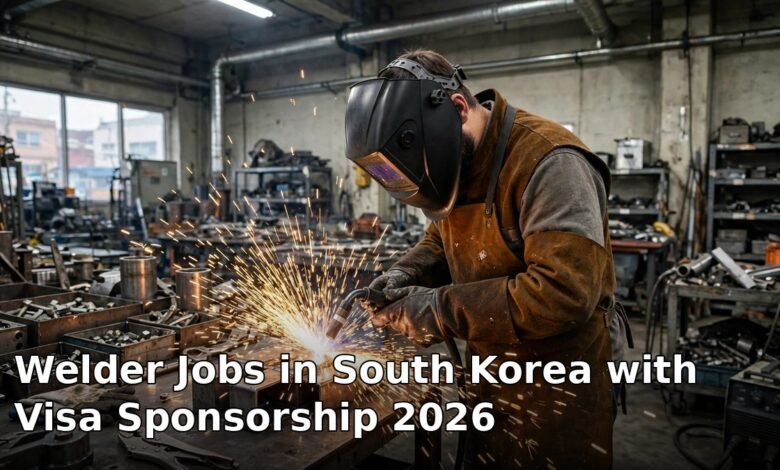
In South Korea the E-9 welder works in manufacturing — small and mid-size metal workshops, shipbuilding subcontractors, machinery plants and construction-material factories. The work is arc and MIG/TIG welding on structural steel, pressure parts and fabricated assemblies, reading basic technical drawings, and following Korean industrial safety standards. This is exactly the E-9 profile: manufacturing is the volume sector of the Employment Permit System, with the 2026 fourth intake round allocating 9,020 manufacturing slots out of roughly 80,000 E-9 workers admitted across the year. Pay follows the Korean minimum-wage law plus overtime — E-9 manufacturing wages in 2026 typically land around KRW 2.1-2.6 million per month including overtime, with dormitory accommodation commonly provided by the employer. The honest market note: this is physically demanding shift work in industrial zones, and the employers who use EPS are small manufacturers that cannot fill roles locally — which is precisely why the government route exists.The Real Route: EPS E-9 for Manufacturing Workers
The real route is Korea’s Employment Permit System (EPS) E-9 visa — Non-Professional Employment. The mechanics are government-to-government: Korea signs EPS memoranda with 17 sending countries, and Pakistan is one of them. The sequence is fixed: you pass the EPS-TOPIK Korean test in your home country, your details enter the EPS roster through your country’s government recruitment channel, Korean employers select candidates from the roster via HRD Korea (an agency of the Ministry of Employment and Labor), a standard employment contract is signed, and the E-9 visa is issued before you travel. The visa is tied to the sponsoring employer, valid up to 4 years and 10 months in total. There is no private-recruitment shortcut: Korean law forbids private agencies from handling E-9 recruitment, and any ‘agent’ selling an E-9 job offer is a scam by definition.Understand the wider market in jobs in South Korea with visa sponsorship for foreigners.
Read our South Korean work visa jobs overview of every Korean work route.
Avoid the fraud traps with our best recruitment agencies in South Korea for foreigners guide.
EPS-TOPIK, the Roster, and the Scam Warning
The single biggest filter is the EPS-TOPIK — the Test of Proficiency in Korean — and it is mandatory. You cannot enter the roster without passing it, and results are valid for two years. Only candidates within the annual country quota advance, so a passing score alone does not guarantee selection; it qualifies you for the roster. Preparation is a months-long project: listening and reading comprehension in Korean, plus in some rounds a skills test. The second accuracy point: entry is ONLY via the EPS roster. You cannot enter on a tourist visa and convert it to E-9 status — that route does not exist, and overstaying destroys any future legal employment chance. The third: never pay a private agent for ‘an E-9 job offer’. Government recruitment is the only channel; fees to agents are the signature of the E-9 scam economy.The Qualification Bar and Arrival Formalities
The qualification bar is: a passed EPS-TOPIK, relevant welding experience or a trade certificate (employers selecting from the roster prefer demonstrable skill), physical fitness for industrial shift work, and a clean record. Age and health standards apply per the EPS rules of your sending country. On arrival you complete MOEL’s post-arrival training, register as an alien within 90 days, and are enrolled in national pension, health insurance, departure guarantee insurance and return-cost insurance. Practical preparation: learn basic Korean workplace vocabulary beyond the test, prepare your documents (passport, medical, police clearance) in advance, and understand that the first contract’s employer, location and dormitory conditions are what you signed — research them through the official channels before departure.How to Apply for Welder Jobs in South Korea with Visa Sponsorship 2026
Start at the official EPS portal linked below — it is the HRD Korea website that carries the program’s application procedures, requirements, notices and forms. Then find your country’s government EPS recruitment channel (in Pakistan this runs through the state overseas-employment machinery, not private agents) and register for the next EPS-TOPIK round. Prepare for the Korean test seriously — it is the gate. Never pay anyone for a job offer, a ‘guaranteed’ roster spot, or visa ‘processing’ outside the official channel; the employer’s EPS application costs are not yours to pay. And verify everything against official Korean government sources: the EPS website and Korea’s immigration portal (hikorea) are the authorities, not social media posts.Apply Now
Employer: HRD Korea (EPS program, official government portal)
Apply Now: EPS Employment Permit System — official HRD Korea portal (start here for the E-9 route)
Frequently Asked Questions
How does the EPS E-9 system actually work?
The Employment Permit System (EPS) is run by the Korean government through HRD Korea. Foreign workers enter only via the EPS roster: your country’s government recruitment channel forwards qualified candidates (EPS-TOPIK passers) to HRD Korea, Korean employers select from the roster, and the visa is issued on that basis. There is no direct private hiring route for E-9 workers.
Do I need to know Korean to work as a welder in South Korea?
Yes. The EPS-TOPIK (Test of Proficiency in Korean) is mandatory for E-9 workers. You cannot enter the EPS roster without passing it. Prepare for the test early — it is the single biggest filter in the whole process.
Can I go to Korea on a tourist visa and convert it to a work visa?
No. Entry on a tourist visa with the plan to ‘convert’ to a work visa is not a legal route for E-9 employment. The E-9 visa is issued only through the EPS roster process before you travel. Anyone advising a tourist-visa conversion is either misinformed or running a scam.
How long can I stay, and can I change employers?
The E-9 visa is tied to the sponsoring employer, with a maximum stay of 4 years and 10 months. Changing employers is heavily restricted — in principle you must stay with the sponsoring employer, and can change only in limited circumstances (such as business closure or wage arrears) with approval. Choose the employer carefully before you travel.
Welder jobs in South Korea with visa sponsorship 2026 are a genuinely government-run route: the EPS E-9 visa exists exactly for manufacturing workers like welders, Pakistan is one of the 17 EPS partner countries, and recruitment runs through the government — which is also why the scam warning is the most important paragraph in this guide. Do not shortcut the accuracy points: the EPS-TOPIK Korean test is mandatory, the visa is tied to the sponsoring employer for up to 4 years and 10 months, and there is no tourist-visa-to-work conversion. Start with the official EPS portal above, prepare for the Korean test, and never pay a private agent for an ‘E-9 job offer’.


