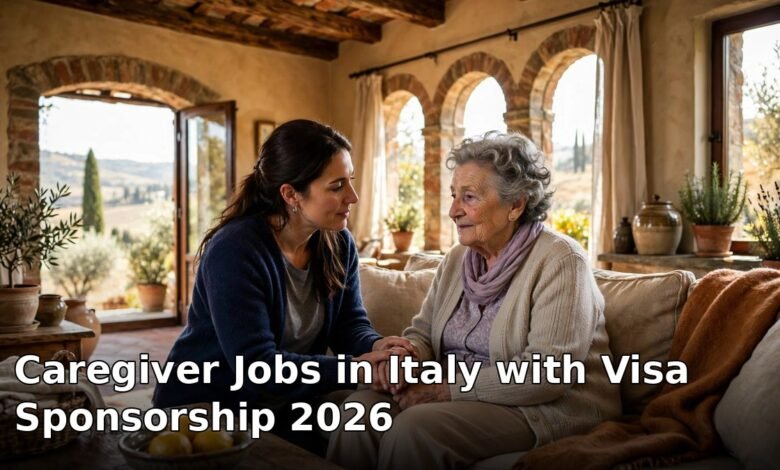
caregiver jobs in italy with visa sponsorship 2026 are a real, quota-backed route: Italy’s Decreto Flussi 2026–2028 reserves 13,600 domestic and family-care slots for non-EU workers in 2026, released through the famous 18 February click day. But the honesty comes first — the Italian family hires you and files the application; you cannot apply for yourself, and no agent can sell you a slot. This guide explains the real Flussi mechanics, the nulla osta chain, honest pay and contract figures, and how to connect with the families and agencies that actually hire badanti.
Start with our Italian work visa process guide — it maps exactly how the Decreto Flussi quota and nulla osta system works.
What Caregivers (Badanti) Do in Italy — and Why Families Are Hiring
In Italy, the caregiver is called the badante: a live-in or hourly care worker who looks after an elderly or non-self-sufficient person inside the family home. The work is personal and hands-on — assisting with bathing, dressing, mobility and meals, preparing food to dietary requirements, reminding and monitoring medication, keeping the home in order, and above all providing companionship for someone who would otherwise be alone. The demand is structural, not cyclical: Italy’s working-age population is shrinking (281,000 more deaths than births were recorded in 2024 alone), the over-65 population keeps growing, and an estimated 1.5 million family assistants already work across the country. Typical pay for live-in badante roles runs around €1,100–€1,600 per month plus board and lodging, with agency-placed overnight shifts quoted around €60–€130 per night depending on region and arrangement. One honest note up front: this is Italian-language, in-home work. You live and work with an elderly Italian person — Italian is the working language, not an optional extra.
The Real Route: Decreto Flussi 2026 — Quotas and Click Days
The real route is Italy’s Decreto Flussi (Flow Decree) 2026–2028, which sets numerical quotas for non-EU workers over three years: 164,850 entries for 2026, rising to 165,850 in 2027 and 166,850 in 2028. Domestic and family care work (lavoro domestico) is a named, ring-fenced category: 13,600 entries in 2026, 14,000 in 2027 and 14,200 in 2028. The quotas are released on annual click days on a first-come, first-served basis — for 2026 the dates were 12 January (seasonal agriculture), 9 February (seasonal tourism), 16 February (non-seasonal work) and 18 February (domestic and family care workers). Slots can vanish in minutes. The single most important fact: this is an employer-sponsored system. The Italian family (or care agency) prepares the application in advance on the Ministry of the Interior’s portal and submits it at 09:00 on click day. The worker cannot self-apply, cannot reserve a slot, and cannot buy one from an agent.
For the full permit mechanics behind this route, read our Italian work visa process guide — it maps how the Decreto Flussi nulla osta system works.
See jobs in Italy for foreigners with visa sponsorship for the wider picture of sponsored sectors in 2026.
Compare entry-level options in unskilled jobs in Italy for foreigners if you are weighing care work against other Italian routes.
Or compare the care route in caregiver jobs in Canada with visa sponsorship for the North American alternative.
How the Employer-Led Application Actually Works (Step by Step)
Here is the full chain, in the only order that works. First, you connect with an Italian family willing to hire you — this is the hard part, done through the care platforms and agencies Italian families actually use. Second, on click day the family (or its legal representative) submits the hiring application; if it wins a quota slot, the Sportello Unico Immigrazione issues the nulla osta (work authorisation). Third, you are notified and apply for a National D entry visa at the Italian consulate in your country, with the nulla osta, signed contract, valid passport, clean criminal record and supporting documents — consulates now capture biometric data, so build an extra appointment into the timeline. Fourth, after arrival you apply for the permesso di soggiorno (residence permit) at the local immigration office within eight days, and the employment contract is signed in Italy. A word on timing: applications for the 2026 quota remain open until 31 December 2026 if slots are left, but in practice domestic-care places are claimed on or near click day — this is a lottery you enter once a year, not a rolling application.
Pay, Contracts and the Honest Fine Print
Say the pay and contract parts plainly. Badanti work under Italy’s domestic-work collective contract: live-in (convivente) arrangements typically mean around 54 structured hours per week with board and lodging, while hourly and live-out roles run roughly €7–€12 per hour depending on region, experience and specialisation (dementia and post-surgical care pay more). INPS social-security contributions, the tredicesima (13th-month pay) and TFR severance accrual are part of the real cost of a legal hire — which is exactly why serious families use accountants and agencies to stay compliant, and why ‘under-the-table’ offers are a trap: they cannot produce a nulla osta and therefore cannot produce a visa. After five years of legal residence, caregivers become eligible for the EU long-term residence permit, and the domestic-care permit is renewable as long as the employment continues. One caution that matters: private employers can submit a maximum of three applications per year, so families pick carefully — be the candidate who is already document-ready when click-day season approaches.
How to Apply for Caregiver Jobs in Italy with Visa Sponsorship 2026
Caregiver jobs in Italy with visa sponsorship 2026 are won through the channels Italian families genuinely use: national job platforms (InfoJobs.it, Subito.it), specialist badante-matching portals, and established care agencies (Assistenza Group, Privatassistenza, ColfService and similar regional agencies) that maintain databases connecting vetted caregivers with families. Prepare a detailed CV with real care experience and reference letters from previous employers or families; start Italian to at least a functional level; get a first-aid certificate; and never pay anyone for a job offer, a ‘guaranteed’ nulla osta, or a click-day slot — no intermediary can sell what only the authorities issue. One transparency note: no current individual family or agency listing could be verified at write time, so no Apply Now link is published here rather than an unverified one. Register on the platforms above, approach agencies directly, and treat every offer that asks you for money as a scam until proven otherwise.
Frequently Asked Questions
Can I apply for the Decreto Flussi caregiver quota myself?
No. The Decreto Flussi system is employer-driven: the Italian family (or care agency) prepares and submits the application on the government’s click day. Workers cannot file for themselves, and anyone selling you a ‘self-application’ or ‘direct permit’ for a fee is running a scam.
Do I need qualifications to work as a caregiver (badante) in Italy?
No formal qualification is legally required for most badante roles, but the OSS certificate (Operatore Socio Sanitario), first aid certification, dementia-care training and documented care experience significantly improve your chances and your pay. A clean criminal record and a valid passport are mandatory for the visa stage.
Do I need to speak Italian to be a caregiver in Italy?
Not legally, but in practice basic-to-intermediate Italian (around B1 level) is strongly recommended. Care work happens in the home of an elderly Italian person: instructions, medication schedules and emergencies are all in Italian. It also makes the consulate interview and daily life far easier.
What if I miss the 2026 caregiver click day?
Applications for the 2026 quota can be prepared and submitted until 31 December 2026 if places remain — but domestic-care slots are claimed fast on click day. If you miss 2026, the same decree already sets 14,000 domestic-care entries for 2027 and 14,200 for 2028, with new click days each year.
Caregiver jobs in Italy with visa sponsorship 2026 are a real, quota-backed route: the Decreto Flussi 2026–2028 reserves 13,600 domestic and family-care slots for 2026, and the 18 February 2026 click day is the door. But the door only opens through the Italian family that hires you — they file the application on click day, obtain the nulla osta, and you apply for the entry visa at the consulate in that order. No agent, agency or online application bypasses that chain, and there is no worker self-application. Start Italian now, build a care CV with real references, and register on the platforms Italian families actually use. If the 2026 quota fills, the 2027 and 2028 tranches are already legislated — 14,000 and 14,200 domestic-care entries respectively.