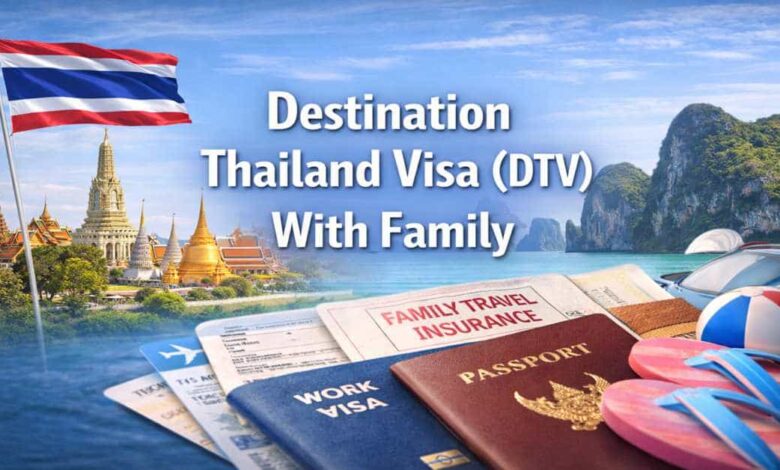
Destination Thailand Visa (DTV) With Family – Full Process: this guide sets out what the route covers, who it is for, and how to check the official requirements before you apply. In Thailand, foreign workers are hired on an employer-sponsored work permit and visa: the employer applies for the permit, and the genuine offer comes first. You should never pay for the offer itself. Requirements, timelines and fees vary by case, so official guidance matters more than any advert or agent’s promise. Read the official process first, and never pay for a guaranteed outcome.
A related opening to compare is English Language Teaching Jobs in Thailand with Visa 2026.
The Thailand Destination Visa (DTV) lets remote workers and digital nomads live in Thailand for up to 180 days per entry on a 5-year multiple-entry visa — and you can bring your spouse and children under 20 with you. You must prove at least 500,000 THB in funds and apply at a Thai embassy or consulate. Below is the full 2026 process, step by step.
If you’re weighing alternatives, compare this route with our guide to Croatia digital nomad visa.
The Destination Thailand Visa (DTV) With Family is a one-of-a-kind visa program that the Thai government created to draw professionals who can work from anywhere in the world, such as digital nomads for work.
As more people around the world choose to work from home, Thailand presents itself as a desirable place for these location-independent professionals to live and work. It has a lively culture, beautiful scenery, and a good climate.
Purpose of the Destination Thailand Visa:
For more options in the same region, see our full breakdown of skill shortage occupations in Europe and Asia.
The main goal of the DTV is to make it easier for workers who work from home to live and work in Thailand for long periods of time. The Thai government wants to boost the local economy through the money they spend and the skills they bring to the country by making these people feel welcome. With the DTV, these professionals can not only learn about Thai culture, but they can also move in and out of the country without having to apply for a visa again.
Key Features:
The DTV has a number of useful tools for digital nomads and people who work from home, such as:
Multiple Entry Privileges
One great thing about the DTV is that it can handle multiple entries. People with a valid visa can enter and leave Thailand as many times as they want during the 5-year period that the visa is good. This freedom is especially helpful for professionals who need to move a lot for work or personal reasons.
Long Stays:
Each time you enter Thailand, you can stay for up to 180 days. You can extend this time once to get an extra 180 days, which means you can stay in Thailand for almost a year without having to leave the country. Because of this feature, the DTV is perfect for people who want to set up a short base in Thailand and keep working from home.
Flexibility for Various Professions
The DTV is designed with flexibility in mind, catering to a wide range of professionals who rely on digital technologies to perform their jobs remotely. Whether you’re a freelance writer, a software developer, or a consultant, the DTV allows you to live and work in Thailand without the need for local employment.
Contribution to the Thai Economy
Thailand wants to get more skilled people and grow its economy, and the DTV is part of that plan. Thailand wants to get money from digital nomads and remote workers who spend money on food, lodging, and other services. They also want to promote cultural exchange.
Check Also: Thailand Work Visa Process – Thai Permit
Bringing Your Family Along on the DTV Thai VISA:
One of the best things about the DTV is that it lets you bring your family to Thailand with you. These are the things you need to know about adding children to your DTV application:
- Eligible Dependents: The DTV allows the primary visa holder to bring their spouse and children under the age of 20. Each dependent must apply for their own DTV, and the same visa validity and stay duration rules apply to them as to the main applicant.
- Application Process for Dependents: Each dependent must fill out a different DTV form and pay the visa fees that go with it. During the process, proof of a link with the main applicant must be shown. Examples include marriage and birth certificates. Once accepted, dependents can enjoy the same benefits as the main visa holder, such as being able to enter and stay in Thailand for longer periods of time.
Eligibility Criteria for Destination Thailand Visa (DTV) With Family:
To be eligible for the DTV, both the main applicant and any children must meet certain requirements:
Main Applicant Criteria for Thai DTV
Age: Must be at least 20 years old.
Financial Requirements:
Proof of Funds:
- Bank Account Balance: Demonstrate at least 500,000 THB (approximately 14,500 USD) in a bank account.
- Consistent Monthly Income: Show a consistent monthly income of at least 80,000 THB (approximately 2,300 USD) for the past three months.
Employment Verification:
- Thai Company Employment: In the event that you work for a Thai company, you are required to show proof of your job and pay.
Freelancers and Digital Nomads:
- Evidence of Ongoing Work: Show that you are financially stable and have a job by showing proof of ongoing work, like contracts, bills, or proof of earnings.
- Health Insurance: Must have health insurance that covers at least 50,000 USD in COVID-19 treatment in Thailand.
- Background Check: Must have a clean record and pass a security check.
Dependent Criteria:
- Relationship: People who depend on the main candidate must be either their spouse or children under the age of 20.
- Financial Support: The main applicant must show proof that they have enough money to take care of their children in Thailand.
- Documentation: Birth certificates for children and marriage certificates for spouses are needed.
How to Apply for Destination Thailand Visa (DTV) With Family?
The process of applying for the DTV is easy and can be done online. Here is a step-by-step guide:
Gather Required Documents
Main Applicant Process:
- Completed DTV application form
- Passport with at least 6 months validity
- Recent passport-size photos
- Proof of funds (bank statements, employment contract, or evidence of freelance work)
- Health insurance certificate
- Police clearance certificate
Dependents Process:
- each dependent’s DTV entry form must be filled out.
- Each dependent must have a passport that is good for at least six months.
- Passport-sized pictures taken recently of everyone who lives with you.
- Proof that you are related to the main candidate, like a marriage certificate or birth certificate.
Prepare Online Application:
- Go to https://fukuoka.thaiembassy.org/en/page/endtvvisa to get a valid Thai e-Visa.
- Fill out the online application form for the main applicant after making an account.
- Upload all the papers that are needed for the main applicant.
- This person needs to pay the visa fee, which is 2,000 Thai Baht.
- Do the same thing for each dependent, making different applications and uploading their files each time.
- Pay the fee for each dependent visa.
Submit Application and Wait for Approval:
- Send all of your forms online.
- Wait for the Thai customs office to handle your requests. It usually takes about 15 business days to finish.
- Once your visa is accepted, you will get an email telling you so.
Travel to Thailand:
- You and your family can go to Thailand once your visa is accepted.
- You will need to show your passports and letters approving your visas at the customs checkpoint.
- The DTV stamp will be put on your passports by the immigration worker. This lets you stay in Thailand for up to 180 days.
Conclusion:
Digital nomads and independent workers can really enjoy life in one of Southeast Asia’s most exciting countries with the Destination Thailand Visa. The DTV gives you the freedom and flexibility to make Thailand your home away from home, whether you want to work from the beaches of Phuket, the busy streets of Bangkok, or the peaceful mountains of Chiang Mai.
Frequently Asked Questions:
Thailand DTV visa with family: Requirements & Eligibility
Applicants exploring this option often also read our guide on Barbados Welcome Stamp.
For a neighbouring option in the same field, see Jobs in Thailand for Foreigners 2026 – Work Visa Sponsorship.
Applicants also compare Jobs in Thailand with Visa Sponsorship for Foreigners.
How does this route work, and who is it for?
In Thailand, foreign workers are hired on an employer-sponsored work permit and visa: the employer applies for the permit, and the genuine offer comes first. You should never pay for the offer itself. Eligibility and process details should always be checked against the official guidance for your own case, and you should never pay an agent for a guaranteed approval.
Who is eligible, and what documents are usually required?
It depends on the route: most visa and residence routes ask for a valid passport, proof of purpose (an offer, admission, funds or family link, as the route requires), and any role-specific qualifications. Requirements change, so confirm the current list in the official guidance before you apply.
How long does the process take, and what does it cost?
Timelines and fees vary by country, route and case, and published processing times are estimates rather than promises. Check the current official fee and timeline for your route, and be wary of anyone promising a fixed approval date.
How do I apply safely and avoid scams?
Apply through official channels, verify any employer, agent or adviser independently, and never pay a fee for a guaranteed visa, job offer or approval. Genuine routes do not sell approvals, and pressure to pay quickly is a warning sign.
For the next step, read our guide to Recruitment Agencies in Thailand for Foreigners & Citizens.
For a related pathway, see European digital nomad visas for families — requirements, costs and timelines explained.
Before you decide, review Belgium work visa with family to compare requirements side by side.
Destination Thailand Visa (DTV) With Family – Full Process 2026 is worth understanding before you apply: check the official requirements for your own case, confirm every claim through official channels, and never pay for a guaranteed visa or job offer.
Keep an eye on Thailand Opens Long-Term Resident Visa – Update Released.







6 Comments