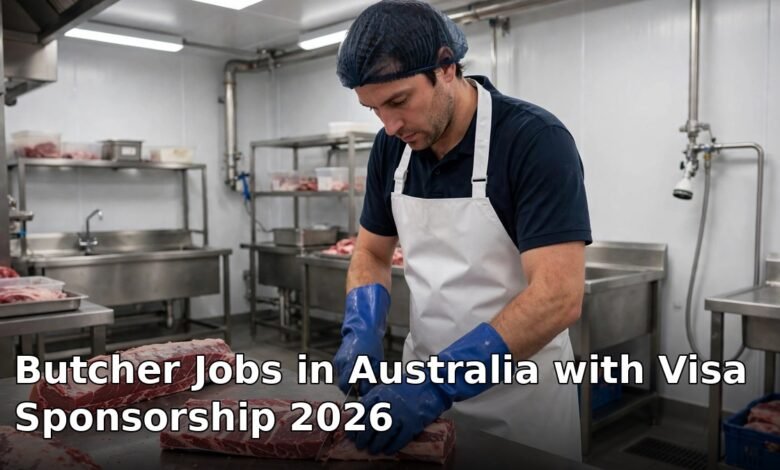
Butcher jobs in Australia with visa sponsorship 2026 are a real, rules-based route for experienced meat workers: Butcher or Smallgoods Maker is ANZSCO 351211, an occupation with a documented national shortage in every Australian state and territory. The standard pathway is the employer-sponsored Subclass 482 Skills in Demand visa (Core Skills stream), with Trades Recognition Australia as the assessing authority. A note on sourcing: no individual live butcher listing with explicit sponsorship wording could be verified at write time (sponsorship-aware marketplaces showed live sponsored butcher demand — e.g. a Gold Coast market listing around A$90,000 plus super — but no individually linkable ad). The salary and visa figures in this guide reflect official thresholds and genuine market data. This guide covers the ANZSCO 351211 route, the TRA assessment, the salary floor, where sponsors actually hire, and how to apply — with one honest rule: no overclaiming of direct PR pathways.
New to employer sponsorship? Read our Australian work visa types 2026 guide first — it explains how the 482, 494 and 186 visas fit together so you can tell which one a butcher sponsor is actually offering.
What Do Butchers Do in Australia’s Meat Industry?
Butchers in Australia select, cut, trim and prepare meat for sale or supply — removing bones, portioning carcasses, mincing and grinding, making smallgoods, operating processing machines, and maintaining strict food-safety and cold-chain standards. The work splits across retail butchery (customer-facing shops and supermarket meat departments) and industrial meat processing (large plants and regional abattoirs handling high-volume production on shift schedules). Typical pay runs AUD 70,000–95,000 a year for full-time roles, with overtime common in plants and senior or retail-lead roles reaching A$90,000 plus superannuation — though any sponsored offer must still clear the visa salary floor. Employers expect 1–3 years of experience, knife and cutting skills, and food-safety knowledge; the shortage is documented across every state, which is why processors are among the most proven sponsors in the skilled trade system.
ANZSCO 351211: The Honest 482 Employer-Sponsored Route for Butcher Jobs in Australia with Visa Sponsorship
Butcher or Smallgoods Maker is ANZSCO 351211, an occupation with a documented national shortage in all states and territories — the legal foundation of the route, because the Subclass 482 Core Skills stream is only open to listed occupations, and the shortage is what makes employers willing to sponsor. The standard pathway is the employer-sponsored 482 Skills in Demand visa (Core Skills stream): an approved Standard Business Sponsor — typically a meat-processing plant, regional abattoir or retail group — nominates the butcher for a full-time role with a 2–4 year stay. Here is the honest core of this post: do NOT expect a direct permanent-residency pathway. Permanent residency becomes realistic later — most commonly via the Subclass 186 Employer Nomination Scheme’s Temporary Residence Transition stream after a period with the sponsoring employer — but the article’s honest center is employer-sponsored 482, not PR. A note on sourcing: no individual live butcher listing with explicit sponsorship wording could be verified at write time (sponsorship-aware marketplaces showed live sponsored butcher demand, but no individually linkable ad), so the figures here reflect genuine market data.
Starting in the industry? See butcher/meat preparation jobs in Australia for foreigners for the broader picture.
Food manufacturing roles are closely related: food production worker jobs in Australia for foreigners 2026.
In another food trade, see bakery worker jobs in Australia with visa sponsorship 2026.
Entry-level option in the same sector: mushroom picker jobs in Australia with visa sponsorship.
The TRA Skills Assessment: What Sponsored Butchers Must Complete
For Butcher or Smallgoods Maker (ANZSCO 351211) the assessing authority is Trades Recognition Australia (TRA). Expect to provide documentary evidence of identity, qualifications or on-the-job training, detailed employment history with duties performed, and employer references — and, depending on the pathway, a technical assessment with an approved Registered Training Organisation demonstrating practical cutting and processing skills. The minimum requirement is an AQF Certificate III (including at least two years of on-the-job training) or an AQF Certificate IV, and assessments typically take 6 to 16 weeks. Begin this before approaching employers: a positive TRA outcome is the single strongest signal you can send a processor, because it proves you have cleared the hardest hurdle before costing them anything. Experienced butchers without formal Australian qualifications may explore Recognition of Prior Learning toward the trade qualification, but it only helps where it lines up with the occupation and visa requirements.
Salary Rules: The A$79,423 Floor, English and the Scam Warning
Every 482 offer must meet the Core Skills Income Threshold — A$79,423 a year for nominations lodged from 1 July 2026, or the relevant market salary rate, whichever is higher. This matters for butchers because the market range (AUD 70,000–95,000) straddles the threshold: an offer at the lower end cannot support a nomination even where the job is genuine, so always measure the offer against the threshold, not the average. On English, the 482 stream requires IELTS 5.0 overall (Functional / Vocational) unless an exemption applies; different subclasses carry different requirements. Food-safety training and, in some states, meat-handling licensing are practical requirements separate from the visa, and regional plants may offer on-the-job training. And the scam rule: sponsorship and nomination costs sit with the employer by law — never pay anyone for a job offer or a nomination.
How to Apply for Butcher Jobs in Australia with Visa Sponsorship 2026
Start the TRA skills assessment first, then target the employers who genuinely hire butchers: regional processing plants, metropolitan abattoirs, retail butchery groups, supermarket meat departments and wholesale suppliers. Stay flexible on location — rural plants in Queensland, New South Wales and Victoria face the sharpest shortages and sponsor more readily than metropolitan shops. Search job boards that let you filter for visa sponsorship, sponsorship-aware marketplaces, and the Department of Home Affairs register of approved sponsors. Apply with an Australian-format CV (two pages, no photo) that states your years of butchery experience, carcass breakdown and smallgoods skills, and your TRA assessment status. State your sponsorship need in the first message — sponsor-ready processors screen for this early. Once you hold a written full-time offer at or above the salary floor, the employer nominates you and you lodge the 482 visa application; a realistic end-to-end timeline is 6 to 12 months.
Frequently Asked Questions
Which visa covers butcher jobs with sponsorship in Australia?
The Subclass 482 Skills in Demand visa (Core Skills stream) is the standard route. An approved Standard Business Sponsor — typically a meat-processing plant, regional abattoir or retail group — nominates the butcher for a full-time role, with a 2–4 year stay. Regional employers may also use the Subclass 494, and 186 Employer Nomination becomes possible later after a period with the sponsor.
What is the ANZSCO code for butchers and how does the skills assessment work?
Butcher or Smallgoods Maker is ANZSCO 351211, a skilled occupation with a national shortage across all states and territories. The assessing authority is Trades Recognition Australia (TRA), which requires evidence of qualifications or experience, employment history with duties, and employer references — a technical assessment may also apply.
What do sponsored butchers earn in Australia in 2026?
Full-time sponsored butchers typically earn AUD 70,000–95,000 a year, with qualified roles at major plants or retail groups reaching A$90,000 plus superannuation and overtime. Any 482 offer must meet the Core Skills Income Threshold (A$79,423 from 1 July 2026) or the market salary rate, whichever is higher — so the lower end of the range cannot support a nomination.
Which Australian employers sponsor butchers?
Regional processing plants, metropolitan abattoirs, retail butchery groups, supermarket meat departments and wholesale suppliers. Sponsorship is concentrated where the shortage is sharpest — rural Queensland, New South Wales and Victoria plants — so stay flexible on location; regional employers sponsor more readily.
Butcher jobs in Australia with visa sponsorship 2026 are a real, rules-based route — ANZSCO 351211 has a documented national shortage across every state, the TRA assessment is defined, and meat-processing employers are proven sponsors. The honest core of this post is employer-sponsored 482, not a direct PR pathway: start the assessment first, target real processors and retail groups, declare your sponsorship need up front, and never pay for a nomination. Do that, and the nomination is a process, not a gamble.