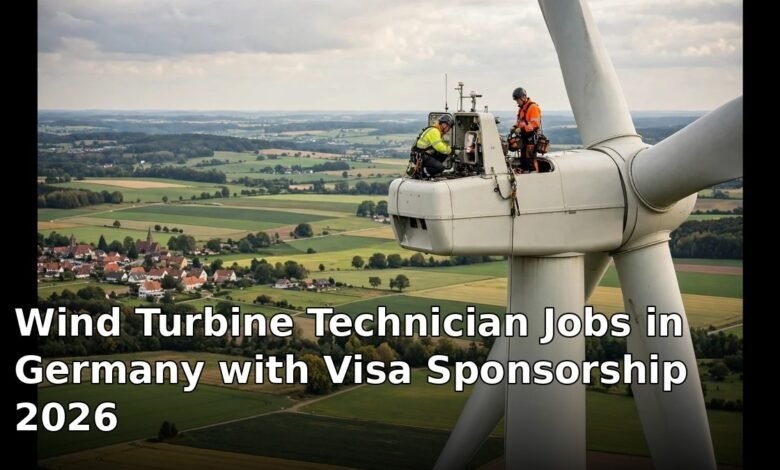
Wind turbine technician jobs in Germany with visa sponsorship 2026 carry one of the strongest credibility anchors in European labour migration: Germany’s Skilled Immigration Act EXPLICITLY names wind technicians (alongside solar installers) as eligible for short-term contingent employment — up to 8 months, no vocational degree required, employer-paid travel, collective-bargaining pay, Federal Employment Agency approval. Behind that sits a 200,000+ worker gap in the Energiewende build-out, and conventional employers like Vestas hiring service technicians on IG Metall collective-agreement terms. This guide separates the two real routes — the no-degree contingent season and the vocational long-term track — and shows how to apply for each.
For the whole German system, start with our jobs in Germany with visa sponsorship guide — it maps every current route from Blue Card to Opportunity Card.
What Wind Turbine Technicians Do in Germany
A wind turbine service technician keeps onshore turbines turning: scheduled maintenance to standardised plans, fault diagnosis from electronic and mechanical error messages, repairs carried out in two-person teams, retrofits to improve turbine efficiency, and digital documentation of every job. Vestas’s live Fulda posting — the verified listing in this guide — describes exactly this profile for its German service region, with the technician home most evenings and regional travel only during induction. The job is physically demanding (working at heights is non-negotiable), safety-governed (GWO-standard culture, DIN VDE 0105-100 electrician qualification provided through the Vestas Academy), and well-compensated by industrial standards: the Fulda role pays under the IG Metall in-house collective agreement, with 30 days’ vacation plus Christmas Eve and New Year’s Eve off, no shift work, an overtime account and sabbatical option. German wind employers compete on these terms because the workforce gap is real — Clean Energy Wire cites a 200,000+ worker shortfall in the Energiewende build-out.
The Named-in-Law Route: Short-Term Contingent Employment (No Degree Needed)
Here is the fact that makes this occupation special, and the research file insists it is stated exactly: Germany’s Skilled Immigration Act includes a short-term contingent employment route (kurzfristige kontingentierte Beschäftigung) that EXPLICITLY names wind technicians — alongside solar installers — as eligible occupations. The terms: up to 8 months of employment in peak-season work, NO vocational degree required, the employer covers your travel costs, pay follows collective-bargaining terms, and the Federal Employment Agency approves the arrangement. This is not a loophole or an agent’s invention; it is written into the immigration framework as a deliberate answer to the renewables labour shortage. For overseas technicians without German vocational qualifications, this is the most honest entry route in the German system: you arrive through a named legal provision, work a defined season on wind farms, and build the German site experience that every longer-term route rewards.
See the wider market in our jobs in Germany with visa sponsorship guide.
The sister trade named in the same law: solar installer jobs in Germany with visa sponsorship 2026.
Planning the long-term lane? Read how to apply for the Germany Opportunity Card.
Compare skilled worker jobs in Germany for the standard vocational routes.
Long-Term Routes: Recognition Partnership and the Opportunity Card
Eight months is a season, not a career — so plan the second step before the first ends. The recognition partnership (Anerkennungspartnerschaft) lets you enter Germany and work while your foreign qualification goes through the equivalence process, which suits electricians and mechatronics technicians whose training roughly matches German standards. The Opportunity Card (Chancenkarte) is the points-based job-seeker route: points for qualifications, experience, language and age let you live in Germany for up to a year while hunting for a qualifying job — wind employers with 200,000 unfilled roles are exactly the market you want to be standing in. EU Blue Card is the high-salary lane and generally out of reach for technician pay bands, so do not let an agent sell it to you. The realistic ladder: contingent season → German site experience and employer references → recognition partnership or Opportunity Card → long-term service-technician contract on collective-agreement terms.
Salary, Terms and What Employers Actually Screen For
Two pay worlds exist side by side. Conventional service-technician roles at the big OEMs pay under IG Metall in-house collective agreements — permanent contracts, 30 days’ vacation, company bike and pension extras, and structured upskilling through academies like Vestas’s. Contingent-employment pay follows collective-bargaining terms for the sector, with travel covered by the employer. What employers screen for, beyond the route-specific rules: completed vocational training in electrical engineering, electronics, industrial mechatronics or energy/building technology for standard roles; a valid Class B driving licence (BE support sometimes funded); comfort with Microsoft/iOS/SAP documentation tools; and language — ‘very good German and good English’ is the literal Vestas Fulda requirement. For the contingent route the formal bar is lower, but candidates who arrive with basic German and GWO safety certificates get picked first. Either way, get your trade certificates translated and ready, and never pay a ‘placement fee’ to a middleman — Vestas itself publishes recruitment-fraud warnings, and legitimate German employers never charge candidates.
How to Apply for Wind Turbine Technician Jobs in Germany with Visa Sponsorship 2026
Route one — you hold an electrical/mechatronics vocational qualification and speak German: apply directly to OEM service postings like the verified Vestas Fulda listing below. Your CV should be stripped of photos and personal data (Vestas explicitly asks for this), focused on qualifications, turbine or electrical experience, driving licence and language levels. Route two — no German vocational degree: target wind-farm operators and service contractors hiring under the contingent-employment provision, and state your availability for the peak season clearly; recruitment agencies specialising in wind (the Darwin Recruitment Vestas travel-technician posting shows the agency layer) can be legitimate, but verify every fee arrangement — you should not be paying for the job. In both routes, declare your visa need in the first message and ask the employer to confirm the sponsorship mechanism in writing. Build GWO Basic Safety Training if you can — it is the industry’s common currency and shortens every employer’s decision. And the standing rule: confirm the employer’s route before you spend money on language courses or document translations aimed at the wrong pathway.
Apply Now
Employer: Vestas Deutschland GmbH
Frequently Asked Questions
Is it really true that German law names wind turbine technicians specifically?
Yes — this is the credibility anchor of the whole route. Germany’s short-term contingent employment provision explicitly names wind technicians (alongside solar installers) as eligible peak-season occupations. It allows up to 8 months of work with no vocational degree required, the employer covering travel costs, pay under collective-bargaining terms, and approval by the Federal Employment Agency.
Do I need a vocational degree to work on wind turbines in Germany?
No. The short-term contingent route explicitly requires no vocational degree — that is its entire point for peak-season trades. Conventional long-term service-technician roles (like Vestas’s standard postings) do ask for completed vocational training in electrical engineering, electronics or mechatronics, plus fluent German. Match the route to your profile, not the other way round.
How do I stay in Germany beyond the 8-month contingent period?
The short-term route caps at 8 months. For longer stays the realistic options are the recognition partnership (work while your foreign qualification is assessed for equivalence) and the Opportunity Card (Chancenkarte) points-based job-seeker residence. The Energiewende worker gap of 200,000+ means employers have every incentive to convert proven contingent workers onto longer tracks.
What German language level do I need?
Standard German postings require very good German and good English — Vestas’s Fulda listing states this explicitly — plus a Class B driving licence and comfort working at heights. The short-term contingent route does not formally require German, but basic German dramatically improves your hireability and your daily life on site.
Wind turbine technician jobs in Germany with visa sponsorship 2026 are a rare case where the law names your occupation outright — the short-term contingent employment route explicitly covers wind technicians and solar installers for up to 8 months with no vocational degree required, the employer covering your travel and the Federal Employment Agency approving the terms. For the long game, the recognition partnership and the Opportunity Card turn service experience into a residence track, and conventional employers like Vestas keep hiring vocationally qualified technicians with fluent German on IG Metall terms. Start with the verified Vestas listing if you hold an electrical or mechatronics qualification; otherwise build your profile toward the contingent-employment route through wind-industry employers. Either way, confirm the employer’s sponsorship route in writing before you spend money on anything.


