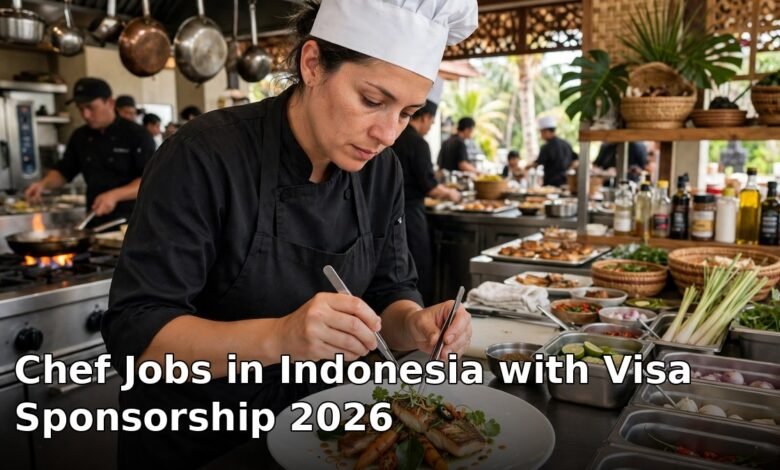
Chef jobs in Indonesia with visa sponsorship 2026 run on the RPTKA-based work authorisation — the employer’s Foreign Worker Utilization Plan, approved by the Ministry of Manpower, whose ratification for the individual worker itself functions as the work permit. The worker then enters on a VITAS limited-stay visa and converts it to a KITAS after arrival. Two corrections come first, because old guides get both wrong: the 1-to-10 local-to-foreign ratio is not live law — it was revoked in 2015 — and general kitchen-hand hiring is not the route. This guide covers the route that does exist: international-cuisine specialists in Bali and Jakarta hotels and restaurants, hired by an employer that trains an Indonesian understudy for the role.
Check chef jobs in Malaysia with visa sponsorship 2026 for the comparison.
What Chefs Do in Indonesia — and Where the Jobs Are
Indonesian chef work for foreign hires concentrates in Bali and Jakarta, in international hotels, resorts and restaurants, where employers need specialists in international, Japanese, European, Middle Eastern and other world cuisines, plus pastry and bakery specialists. A chef de partie on a station, a sous chef and an executive chef are the realistic foreign-hire grades — not general kitchen hands, whose roles Indonesian nationals fill. Basic Bahasa Indonesia is expected in most kitchens, and the employer may need to provide language training. A chef who cannot show a cuisine specialism and a track record in it will struggle to pass the employer’s core test: that the position cannot be filled by an Indonesian national.
The Real Route: RPTKA Approval, Then VITAS, Then KITAS
The mechanics are employer-led and run in order. The employer first gets its RPTKA approved by the Ministry of Manpower, filing on the OSS system with the company deed, business number (NIB), tax number (NPWP), manpower report (WLKP), BPJS registration, organisation chart, an employment contract in Bahasa Indonesia or bilingual, and the Indonesian understudy appointment plus training plan. The RPTKA ratification for the individual worker functions as the work permit — it replaced the former IMTA in 2018, so any guide still describing an IMTA application is out of date. The worker then enters on a VITAS limited-stay visa and converts it to a KITAS after arrival. The permit typically runs 12 months and is extendable.
Check cook jobs in Australia with visa sponsorship 2026 for the comparison.
Check caregiver jobs in Italy with visa sponsorship 2026 for the comparison.
Check barista jobs in New Zealand with visa sponsorship 2026 for the comparison.
Check chef jobs in Ireland with visa sponsorship 2026 for the comparison.
The Understudy Rule — and the Revoked 1-to-10 Myth
The understudy rule is the heart of Indonesian foreign hiring, so state it exactly: the employer must appoint and train an Indonesian understudy (pendamping) for each foreign worker, with a training plan, so knowledge transfers to the local workforce. That is the current requirement. The old 1-to-10 rule from the 2015 manpower regulation was revoked by a later 2015 regulation, and any writer, recruiter or employer quoting a 1-to-10 ratio as live law in 2026 is wrong — correct them, and do not build an application around it. Positions that Indonesian nationals can fill, and restricted roles such as human-resources positions, are not open to foreign hires at all, whatever the recruiter promises.
Pay, Contracts and the Honest Fine Print
Pay in Indonesian chef roles is set by the employer contract in rupiah, at or above the regional minimum wage for the location — Bali and Jakarta rates differ, so a single national figure would mislead. The employer also pays the DKPTKA compensation fund of 100 US dollars a month per foreign worker, and BPJS social-security enrolment is mandatory. The permit is tied to the employer and the role, and the understudy plan is not paperwork to be filed and forgotten: it is a condition of the authorisation. The classic trap in this market is the kitchen-hand offer dressed up as a specialist role: if the job description reads like general kitchen work, it will fail the cannot-be-filled-locally test, and any upfront fee paid for it is lost.
How to Apply for Chef Jobs in Indonesia with Visa Sponsorship 2026
Chef jobs in Indonesia with visa sponsorship 2026 are found through Indonesian hotels and restaurants directly: the Bali and Jakarta international hotel groups advertise specialist chef roles on their career pages and through licensed recruiters. One live example at write time, verified by opening the listing itself: Viva Dash Hotel Bali in Seminyak advertising a full-time Chef de Partie (CDP) role, published 21 October 2026 with applications by 30 October 2026 (see Apply Now below). That deadline is days away from the 27 October write date, so apply immediately if it fits you, and confirm RPTKA sponsorship and the understudy plan with the employer before signing. Never pay anyone for an RPTKA, a KITAS or a chef job.
Apply Now
Employer: Viva Dash Hotel Bali, Seminyak
Frequently Asked Questions
What is Indonesia’s RPTKA for chefs?
The employer’s Foreign Worker Utilization Plan, approved by the Ministry of Manpower. The RPTKA ratification for the individual worker itself functions as the work permit, replacing the former IMTA in 2018. The worker then enters on a VITAS visa and converts it to a KITAS after arrival.
Is there a 1-to-10 local-to-foreign worker ratio in Indonesia?
No, not as live law. The 1-to-10 rule from the 2015 manpower regulation was revoked by a later 2015 regulation. The current requirement is an Indonesian understudy (pendamping) per foreign worker plus a knowledge-transfer training plan.
How long is an Indonesian chef work permit?
Typically 12 months, extendable. The permit is tied to the employer and the role, and the employer pays the DKPTKA compensation fund of 100 US dollars a month per foreign worker, with BPJS enrolment mandatory.
Can a general kitchen hand get an Indonesian work permit as a chef?
No, not as the realistic route. Foreign chef hiring targets international-cuisine specialists whose positions cannot be filled by an Indonesian national. General kitchen-hand roles are filled locally and will fail the employer’s core test.
Chef jobs in Indonesia with visa sponsorship 2026 are a genuine employer-led route: RPTKA approval, ratification as the work permit, a VITAS visa and a KITAS conversion, with an Indonesian understudy trained for every foreign chef. It rewards international-cuisine specialists who target Bali and Jakarta’s real hotel kitchens, and it punishes anyone quoting the revoked 1-to-10 rule or selling general kitchen work as a specialist post. Get the specialism file ready, confirm the understudy plan in writing, and let the employer drive the RPTKA.