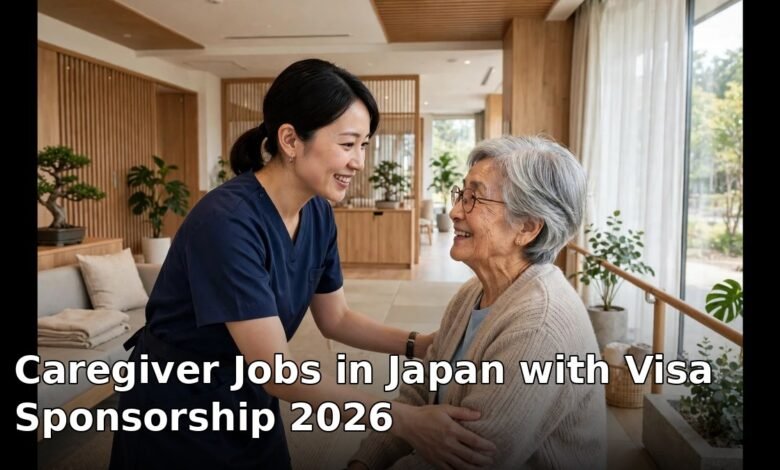
Caregiver jobs in Japan with visa sponsorship 2026 run through one of the most clearly specified labour-migration routes in Asia: Japan’s Specified Skilled Worker (SSW) Type 1 visa for nursing care (kaigo). The requirements are exact and non-negotiable — three exams (the Nursing Care Skills Evaluation Test, JFT-Basic or JLPT N4, and the Nursing Care Japanese Language Evaluation Test), direct employment, a 5-year maximum stay, and wages equal to Japanese staff. The honesty points every guide must state: N4-level Japanese is mandatory, SSW Type 1 offers no family reunification, and the restaurant SSW route is not an option (new applications were suspended in April 2026). This guide lays out the real requirements, the pay, the Kaigo Fukushishi upgrade path, and how to apply without getting scammed.
Start with the visa framework in our Japan Specified Skilled Worker program guide — it covers all 16 SSW fields and how Type 1 and Type 2 differ.
What Caregivers (Kaigo) Do in Japan
In Japan the role is called kaigo — nursing care — and it is facility-based work, not home visits (home-visit care is explicitly excluded from the SSW nursing-care field). You work in elderly care homes (kaigo shisetsu), rehabilitation centres, assisted-living communities or disability group homes, providing physical care tailored to each resident’s condition: bathing, feeding, toileting and hygiene assistance, wheelchair and mobility support, plus related activities like recreation and functional-training support. The official field definition stresses direct, hands-on care — and one clear boundary: no clinical procedures like injections or medication administration unless you are a certified nurse in Japan. Employers range from large social-welfare corporations to mid-size care-home operators; the verified example in this guide’s research, social welfare corporation Sugiwakai in Gifu, advertises full-time care-staff roles at ¥180,000-¥195,000 starting monthly salary with twice-yearly bonuses, qualification allowances and housing support — the standard Japanese employment package, extended to foreign staff on equal terms.
The SSW Type 1 Nursing-Care Route: Three Exams, No Shortcuts
The Specified Skilled Worker (SSW) Type 1 visa, created in April 2019, is Japan’s designated answer to its care labour crisis — and the research file demands the requirements be stated exactly, because agents routinely blur them. For nursing care you must pass THREE separate exams: (1) the Nursing Care Skills Evaluation Test, (2) a Japanese language test — JFT-Basic or JLPT N4 or higher, and (3) the Nursing Care Japanese Language Evaluation Test, which tests the care-specific vocabulary you will actually use on the ward. There are no shortcuts and no waivers; the Japanese bar is genuinely non-negotiable. Employment must be DIRECT with the care facility — dispatch arrangements are not permitted — and the accepting organisation must meet MHLW conditions including council participation and facility-level quotas. The government’s projected intake for the nursing-care field is 135,000 workers over the five years from April 2024 to March 2029, which is the official measure of how badly Japan wants these workers. Separately, candidates from Indonesia, the Philippines and Vietnam have the EPA government-to-government track — mention it once, do not conflate it with the open SSW route.
The visa framework in detail: Japan Specified Skilled Worker program.
Also hiring caregivers: caregiver jobs in Germany with visa sponsorship.
Compare top caregiver jobs in Canada with visa sponsorship.
Already in Japan? See visa-sponsored English teaching jobs in Japan.
Pay, Hours and the 5-Year Ceiling (Stated Plainly)
The pay structure is one of the fairest in Asian labour migration: Japanese law requires SSW workers to receive wages equal to or greater than Japanese nationals doing the same work. Entry-level caregiver base pay starts around ¥200,000 per month before overtime and night-shift allowances, on a regulated working week of about 40 hours with paid annual leave — the BorderPlus program, verified live for this guide, cites ₹1.2-1.5 lakh per month as the equivalent for Indian candidates. Real employer listings confirm the band: ¥180,000-¥195,000 starting monthly salary by education level, with bonuses twice a year (around two months’ salary each), treatment-improvement allowances, qualification allowances, commuting and housing allowances. The honest trade-offs, stated plainly as required: SSW Type 1 caps at 5 years with NO family reunification — if bringing family is non-negotiable for you, this is not your route. The upgrade path is real though: after about three years of work you can sit the national Certified Care Worker exam (Kaigo Fukushishi), which opens a longer-term professional future in Japanese care.
How to Apply: Training Routes, Direct Applications and Scam Rules
Two legitimate channels exist. Channel one is the training-to-placement route: programs like BorderPlus (verified live at write time) take candidates through Japanese training from N5 to N3 over about 29 weeks, then arrange interviews with Japanese recruiters, handle the Certificate of Eligibility and visa paperwork, and provide post-landing support. Read its terms with open eyes: it accepts about 1 in 100 applicants, there is NO legal placement guarantee (it arranges at least two employer interviews per candidate; the Japan track has no placement record yet because placements have not started), and the program costs ₹3,00,000 total with a ₹1,00,000 deposit — skill loans and a training stipend exist, but get every rupee in writing. Channel two is direct application to Japanese care employers and recruiters once you hold the three exam passes yourself — the MHLW and MOFA SSW portals list the official requirements, and licensed supervising organisations handle the mandatory post-arrival support duties. Whichever channel you choose, the scam rules are absolute: never pay for a ‘guaranteed’ SSW visa, never trust a restaurant-SSW offer (suspended April 2026), and verify any recruiter against the official SSW support framework before you sign or pay anything.
Preparing Properly: Language First, Everything Else Second
The single biggest predictor of success on this route is Japanese, so treat it as the project, not a checkbox. N4 is the visa minimum; programs that train you to N3 exist because N3-level comprehension is what actually lets you function on a care ward and pass the care-Japanese exam comfortably. Budget 9-11 months from enrolment to your first day at work if you take a training route (about 6 months of training plus 3-5 months for the Certificate of Eligibility and visa), and longer if you self-study. Gather documents early: passport, education certificates, police clearance and medical fitness reports are standard. Prepare for the employer interview in simple, honest Japanese about your motivation for caregiving — Japanese recruiters screen attitude as hard as certificates. Keep your expectations calibrated: the first year is language-heavy and culturally demanding, night shifts are part of the roster, and the real payoff — Kaigo Fukushishi eligibility and a professional care career — compounds from year three. Start with the verified program link below, but compare it against at least one independent route before you commit money.
Apply Now
Employer: BorderPlus
Frequently Asked Questions
What exams do I need for the SSW nursing-care visa?
Three exams, stated exactly: the Nursing Care Skills Evaluation Test, a Japanese proficiency test (JFT-Basic or JLPT N4 or higher), and the Nursing Care Japanese Language Evaluation Test. The Japanese bar is non-negotiable — without N4-level Japanese you cannot clear the visa requirements, no matter how strong your caregiving experience is.
How long can I stay, and is there a path beyond 5 years?
Five years maximum on SSW Type 1, with periodic renewal. After about three years of work you can sit Japan’s national Certified Care Worker exam (Kaigo Fukushishi), which opens a longer-term professional path in the field — this is the realistic upgrade for anyone who wants to stay beyond the SSW ceiling.
Can my family join me on the SSW caregiver visa?
No. SSW Type 1 does not allow family reunification — say this plainly before you plan around it. The SSW Type 2 category (which allows family) covers only a small set of highly skilled roles in construction and shipbuilding, not nursing care.
What will I earn as a caregiver in Japan?
Care work in Japan is direct employment only — no dispatch or agency labour loopholes — and wages must equal those of Japanese staff doing the same work. Entry-level caregiver pay starts around ¥200,000 per month before overtime and night-shift allowances, on a regulated ~40-hour week with paid annual leave. Night shifts and allowances lift take-home pay meaningfully, and the BorderPlus program cites ₹1.2-1.5 lakh per month as the India-side equivalent.
Caregiver jobs in Japan with visa sponsorship 2026 run through one honest, demanding route: Specified Skilled Worker Type 1 in nursing care — three exams, N4-level Japanese, direct employment, up to five years, wages equal to Japanese staff. The accuracy points to carry: Japanese is non-negotiable, SSW Type 1 carries no family reunification, and the five-year clock rewards those who upgrade to the national Certified Care Worker exam after three years. Do not touch the restaurant SSW route (new applications were suspended in April 2026), and do not confuse the EPA government-to-government track with the open SSW route. If the BorderPlus-style training route fits your budget and timeline, verify every cost and the no-guarantee placement terms in writing before you enrol — and start learning Japanese today, because the language bar is the whole game.