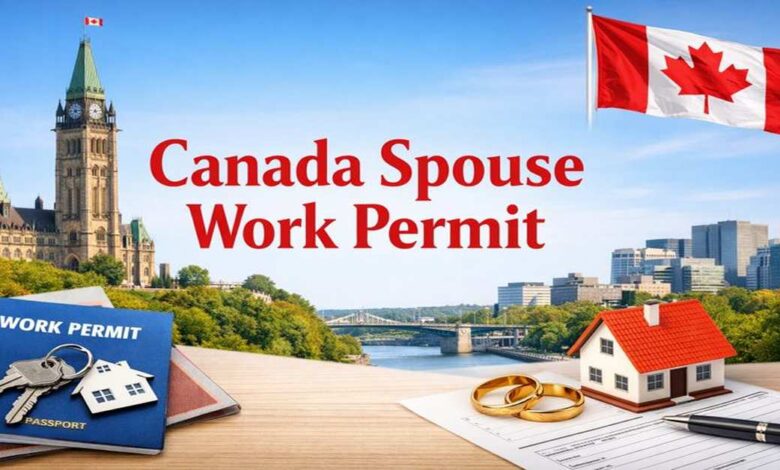
The Canada Spouse Open Work Permit (SOWP) lets the spouse or common-law partner of an eligible international student or skilled worker live and work in Canada. It is an open permit — no job offer or LMIA is needed — and it is usually issued for the same duration as the partner’s study or work permit.
If you’re weighing alternatives, compare this route with our guide to British Columbia’s PNP.
The process of getting your life partner a work permit in Canada can be a fun chance for both of you to live and work in one of the friendliest countries. As a global student, you might be able to help your husband or common-law partner get an Open Work permit. This would let them work anywhere in Canada, as long as they followed some rules.
A Canada labor wage lets people from outside of Canada work in the country for a certain amount of time. To get this permission, you need to show a job offer from a Canadian boss who has a positive Work Showcase Affect Evaluation (LMIA) from Business and Social Development Canada (ESDC). This evaluation shows that the job requires a remote specialist, and there isn’t a Canadian specialist available right now to fill the role.
This order will go over in detail the requirements, the steps needed to prepare an application, and the benefits of getting a work permit for your life partner in Canada.
Eligibility of Canada Spouse Work Permit:
For more options in the same region, see our full breakdown of countries with the fastest work visa processing.
It is imperative to verify that your spouse or common-law partner satisfies the eligibility criteria for an Open Work Allowance (OWP) in Canada prior to applying. The permit enables your partner to work for any employer in Canada, thereby enhancing their work experience and contributing to the establishment of a stable existence.
- Valid Consider Allow: It is imperative that you consider allowing significantly as a universal understudy. This may be necessary for your companion to qualify for the Open Work Allowance. Additionally, you must be enrolled as a full-time student at a recognized educational institution in Canada.
- Enrollment in Specialized Degree Programs: Your companion is eligible to register for the work permit if you are pursuing a Master’s, PhD, or other advanced degree program. Companions of undergraduate students are no longer eligible for SOWP, as Canada has recently implemented new regulations.
- Proof of Enrollment: Confirmation of enrollment, such as transcripts or an affirmation letter from your educational institution, is a critical qualification prerequisite. This illustrates that they are solely conducting a thorough examination of Canada.
- The fulfillment of these criteria qualifies your life partner to apply for the work that is permissible, thereby enabling them to work lawfully and contribute to your shared life in Canada.
Specific Requirements for Canada Spouse Work Permit:
- Employment Contract: A detailed business agreement that delineates the terms of your employment, including your responsibilities and compensation.
- LMIA Number: The number of endorsements for the LMIA issued by your employer.
- Reserves Proof: Demonstrate that you are capable of providing for yourself and any dependents in Canada.
- Health and Character: Police clearance certificates and restorative examinations are conducted.
Benefits of Canada Spouse Work Permit:
- Right to Work in Canada: The Spouse Open Work Permit grants the spouse or companion of a skilled worker or international student in Canada the ability to work for any employer, whether full-time or part-time, in any occupation and location. This permit offers a high degree of flexibility.
- No Job Offer Requirement: The SOWP is distinct from other work permits in that it does not necessitate a job offer prior to application. This allows spouses to arrive in Canada and pursue employment in their desired field without the stress of securing a position beforehand.
- Support for Family Reunification: The SOWP enables spouses and common-law partners to reside and work in the same location as their loved ones who are studying or employed in Canada, thereby facilitating family reunification.
- Professional Experience in Canada: The spouse may qualify for Canadian permanent residency by acquiring Canadian work experience through programs such as the Canadian Experience Class (CEC) or Provincial Nominee Programs (PNP). This employment experience has the potential to enhance future immigration applications.
- Permanent Residency Pathway: The spouse’s work experience and participation in the Canadian job market can assist them in obtaining additional immigration points under Express Entry or other programs, thereby simplifying the process of applying for permanent immigration.
- Financial Stability: The spouse or partner can contribute to the household income by working, which will help cover living expenses, education costs, and other financial demands while in Canada.
- No Employer Restrictions: The spouse is not bound to a particular employer, as it is an open work permit. This allows them to investigate new opportunities, switch jobs, and secure employment in a variety of sectors or regions.
- Career Advancement: Spouses are able to expand their professional networks, acquire new skills, and acquire international work experience by working in Canada. This has the potential to be beneficial for both personal and professional development, both within and outside of Canada.
- Social Benefits Eligibility: The spouse may be eligible for provincial health coverage and other social benefits in certain provinces, contingent upon the validity of the work permit and the specific province’s regulations.
- Opportunity to Experience Canadian Lifestyle: Spouses are afforded the opportunity to immerse themselves in the culture, values, and lifestyle of Canada by residing and working there. This exposure facilitates their integration into Canadian society and the assessment of their long-term settlement plans in Canada.
Check Also: Visa Free Nations to Canada – Visit Here
Application Process of Canada Spouse Work Permit:
- Selecting the Appropriate Program: Determine the most suitable immigration program for your occupation by examining the NOC code. Options include the Express Section framework, Common Chosen One Programs (PNP), and specific work allowance streams.
- Obtain a Job Offer: Secure a substantial job offer from a Canadian employer. In order to demonstrate the necessity of an external employee, the manager may require an LMIA.
- Collect the necessary reports: Gather fundamental reports, including the employment offer letter, confirmation of employment, language proficiency test results, and distinguishing proof.
- Submit an application for a work permit: Develop an online profile that delineates your aptitudes, work experience, education, language proficiency, and other relevant information. Pay the fundamental fees and submit your application through the appropriate migration entrance.
- Biometrics and Therapeutic Examination: Attend a biometrics facility and undergo a critical examination conducted by a licensed physician. The migration authorities are directly responsible for yield.
- Preparation Time: Although handling periods are subject to change, they typically range from two to three months for candidates from abroad. Please be patient as your application is evaluated.
- Obtain the Canada Work Allow: Your Canada Work Allow will be issued to you upon confirmation. Count the type of work, areas, and duration, and evaluate the subtle elements.
- Settlement in Canada: Your work permit specifies that you must arrive in Canada either recently or on the specified date. Adhere to the terms specified in your permit.
- Investigate Changeless Residency Alternatives: If you are interested in establishing a permanent residence in Canada, consider pathways to permanent residency, such as the Canadian Encounter Course or Common Candidate Programs.
Processing Times:
The processing period for a Canada Work Allow is subject to change; however, it typically falls within the range of 2 to 3 months for international applicants.
Conclusion:
Canada permits the acquisition of conjugal employment, which provides both partners with a variety of advantages. Contributing to Canada’s substantial quality of life, it offers work flexibility, opportunities for professional development, and social services. By adhering to the qualification criteria and the application preparation process, your life partner will be able to begin their journey toward an influential career in Canada and experience these benefits.
You and your partner can gain a comprehensive comprehension of the key aspects of living and working in Canada by comprehending the handle and organizing the fundamental archives. This will pave the way for future opportunities and ensure a forever residency.
Frequently Asked Questions:
How long does it take to get a work permit in Canada for a spouse?
Generally, the spouse open work permit Canada’s (SOWP) processing time from India is around three to four months, but it may take even longer, depending on the case’s complexity.
Can my spouse get a work permit in Canada?
When should you apply? Your spouse/partner can apply for a work permit before or after they arrive in Canada. The work permit will usually be issued for the same length of time as your study permit. Your spouse/partner does not need a job offer to apply for a work permit.
Can a spouse work in Canada on a student visa?
If a foreign national is approved for a study permit in Canada with their spouse accompanying, then the spouse will be eligible to apply for a spousal open work permit. This work permit will authorize the spouse to work full-time for any employer in Canada for the same period as their partner’s study permit.
Applicants exploring this option often also read our guide on Canada’s caregiver PR pilots.
Can my spouse get a work permit in Canada?
Yes. The spouse or common-law partner of an eligible international student or skilled worker in Canada can apply for a Spouse Open Work Permit (SOWP). Your partner can apply before or after arriving in Canada, and the permit is usually issued for the same length of time as your study or work permit.
Does the Canada Spouse Open Work Permit require a job offer or LMIA?
No. The SOWP is an open work permit, so your spouse does not need a job offer or a Labour Market Impact Assessment (LMIA) before applying. Once approved, they can work full-time or part-time for any employer in any occupation and location across Canada.
How long does the Canada spouse work permit take to process?
Processing typically takes two to three months for applicants applying from abroad, though times vary by country and case complexity. Some applications from India report three to four months. Always check the current IRCC processing times before making travel plans.
Can a spouse work in Canada while the partner studies?
Yes. If a foreign national holds a valid Canadian study permit and is enrolled full-time at a designated learning institution, their spouse can apply for a spousal open work permit. The permit authorizes full-time work for any employer in Canada for the same period as the partner’s study permit.
For a related pathway, see Canada’s Open Work Permit — requirements, costs and timelines explained.
Before you decide, review skill shortage occupations in Europe and Asia to compare requirements side by side.





3 Comments