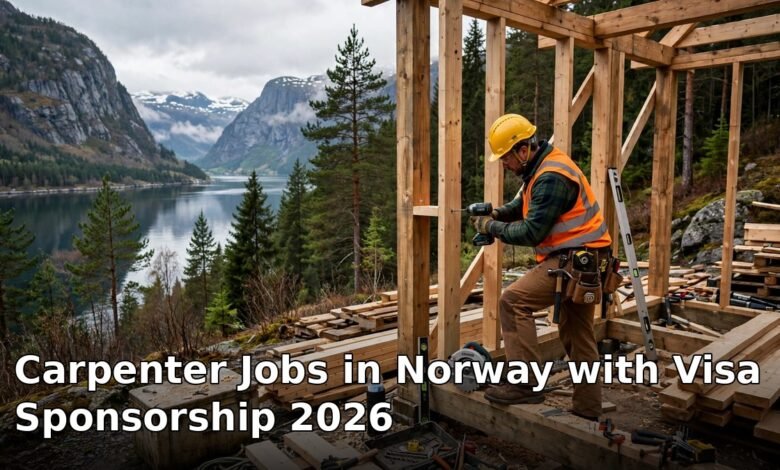
Carpenter jobs in Norway with visa sponsorship 2026 run through one of the clearest skilled-trade routes in Europe: the UDI Skilled Worker residence permit, where carpenter is explicitly named as a qualifying vocational example. Norway’s construction sector keeps hiring, there are no quotas or caps on these permits, and carpentry is not a regulated trade — no separate Norwegian authorisation is required. This guide covers the real 2026 rules: the NOK 472,300/year salary floor, the employer UDI confirmation step added in February 2026, the qualification bar, and how to apply to real Norwegian employers.
New to the Norwegian system? Read our Norway work visa application process and types of work permits guide — it maps every route before you choose one.
What Carpenters Do in Norway (and Where the Demand Is)
Norway keeps building: housing projects, commercial fit-outs, renovation of an ageing building stock and facility-management contracts all keep carpenters in steady demand around the Oslo region and beyond. Day-to-day work is the classic craft mix — wooden framing and structural carpentry, doors and windows, ceilings, flooring and tiles, painting and interior remodelling, plus maintenance rounds for property-management employers like FaciliTec, which is currently hiring carpenters for its Lørenskog/Oslo department. What makes carpenter jobs in Norway with visa sponsorship 2026 especially attractive is structural: carpentry is explicitly named as a qualifying vocational example for the Skilled Worker residence permit, it is not a regulated trade, and there are no caps or quotas on these permits — the visa follows the offer, not a lottery.
The Real Route: UDI’s Skilled Worker Residence Permit (2026 Rules)
The real route is the Norwegian Directorate of Immigration’s (UDI) Skilled Worker residence permit — Norway is in the EEA, not the EU, so this is a purely Norwegian scheme. The qualification bar is vocational and clearly stated: you must have completed a 3-year vocational training programme at upper-secondary level, or have at least 6 years of documented professional experience. You need a concrete, full-time job offer from a Norwegian employer paying at least NOK 472,300 per year in 2026 (the vocational salary floor), or the collective-agreement rate if that is higher. UDI charges an application fee of NOK 6,300. Permits are issued for one year and renewed while the conditions hold, and you become eligible for a permanent residence permit after three years. There are no caps or quotas — meet the conditions and the permit is rules-based.
For the broader trade market, see construction jobs in Norway with visa sponsorship across the country’s building sector.
A related craft role: concrete worker jobs in Norway with visa sponsorship follows the same UDI Skilled Worker route.
Compare the occupation elsewhere in carpenter jobs in Canada with visa sponsorship for the LMIA-based alternative.
For the wider country picture, browse jobs in Norway with visa sponsorship for all sponsored sectors.
The New Step Since February 2026: Your Employer Confirms the Offer in UDI’s System
Since February 2026 there is an extra step that sits ahead of your own application, and it is mandatory. Before you file, your employer must confirm the job offer through UDI’s system and hand you a confirmation code; your application references that code, linking it to the verified offer. In practice this kills the old ‘paper offer’ scam pattern — a genuine offer now carries a UDI-tracked confirmation. Agree this step explicitly with the employer before you sign or submit anything: an employer who will not complete the UDI confirmation cannot sponsor you, and you should treat refusal to do so as a red flag. Keep the code with your application documents; UDI will not process a Skilled Worker application submitted without it.
No Separate Norwegian Carpenter Licence — But Language Is the Real Gate
Two honesty points that most guides blur. First, the good news: carpentry is not a regulated occupation in Norway, so no separate Norwegian trade authorisation is required — this is a real advantage over electricians, who need DSB authorisation. Foreign vocational qualifications may still need recognition by NOKUT (the Norwegian Agency for Quality Assurance in Education), so have your certificates, transcripts and employment references translated and ready. Second, the gate employers actually enforce: language. The verified FaciliTec ad below requires fluency in Norwegian, written and spoken, and that is typical for craft roles involving tenants, suppliers and safety briefings. An English-only applicant faces a far smaller pool of willing sponsors — treat working Norwegian as a practical requirement, not an optional extra.
How to Apply for Carpenter Jobs in Norway with Visa Sponsorship 2026
Start where Norwegian employers advertise craft roles: finn.no is the country’s dominant job board, and company career pages carry the rest — the verified FaciliTec AS carpenter ad linked below is one live example at write time (published 2026-10-01, real company, org. no. NO 995 437 996). Apply with a CV that documents your vocational training or years of experience concretely — UDI will check this — and state your permit need honestly, confirming the employer will complete the UDI confirmation step. Never pay anyone for a job offer or ‘guaranteed’ residence permit: the application fee is NOK 6,300 paid in the official process, and only UDI decides. Before you rely on any ad, verify three things in writing: full-time hours, an annual salary at or above NOK 472,300 (or collective-agreement pay), and the employer’s commitment to the UDI confirmation code.
Apply Now
Employer: FaciliTec AS (via facilitec.no)
Apply Now: Snekker/Tømrer (Carpenter) — FaciliTec AS, Lørenskog/Oslo, Norway (live company listing)
Frequently Asked Questions
Do I need a Norwegian licence or authorisation to work as a carpenter?
No. Carpentry is not a regulated occupation in Norway, so you do not need a separate Norwegian authorisation — unlike electricians, who must be authorised by the Directorate for Civil Protection (DSB). You do, however, need to satisfy UDI’s qualification requirement: a completed 3-year vocational training at upper-secondary level, or at least 6 years of documented professional experience. Foreign vocational documents may also need recognition by NOKUT.
What salary must my Norwegian carpenter job offer pay in 2026?
Your job offer must pay at least NOK 472,300 per year (the 2026 vocational salary floor), or the pay set by the applicable collective agreement if that is higher. UDI checks the offered pay against Norwegian wage norms for the occupation — an offer below the floor means the permit is refused, so confirm the annual NOK figure in the written offer.
What is the employer UDI confirmation code required since February 2026?
Since February 2026, the employer must first confirm the job offer through UDI’s system and give you a confirmation code before you can submit your Skilled Worker application. The code links your application to the employer’s verified offer and is mandatory — without it, the application cannot be filed. Agree this step with the employer before you apply.
How long is the permit valid, and when can I get permanent residence?
The Skilled Worker residence permit is issued for one year at a time and renewed as long as the job and conditions continue. After three years of continuous legal residence on this basis you can apply for a permanent residence permit, provided you meet the PR requirements. There are no annual caps or quotas on Skilled Worker permits.
Carpenter jobs in Norway with visa sponsorship 2026 run on one of Europe’s clearest skilled-trade routes: the UDI Skilled Worker residence permit, where carpenter is explicitly named as a qualifying vocational example, with no quota and no separate trade authorisation to fight over. The 2026 mechanics are simple to state: a full-time concrete offer paying at least NOK 472,300/year (or collective-agreement rates), a completed 3-year vocational training — or 6+ years of documented experience — the employer’s UDI confirmation code since February 2026, and a NOK 6,300 fee. The practical gates are the real ones: working Norwegian on most employer ads, and foreign vocational documents that may need NOKUT recognition. Meet those, find an employer who will complete the UDI confirmation step, and the permit is rules-based — no lottery, no cap. Start with the verified FaciliTec listing above and check every ad against the salary floor before you invest in the move.