construction worker jobs in croatia with visa sponsorship 2026 are one of the most genuine blue-collar routes into the EU: construction sits on Croatia’s official shortage list, the old quota system is gone, and the employer-led stay-and-work permit is built for exactly this hiring. The honesty comes first — the permit is tied to the employer, the employer must clear 2026’s financial checks, and you cannot self-apply. This guide explains the real MUP permit mechanics, the April 2026 employer rules, the honest warnings, and how to apply.
New to the Croatian system? Read our Croatia work visa process guide first — it maps how the combined stay-and-work permit actually works.
What Construction Workers Do in Croatia — and Why Employers Are Hiring
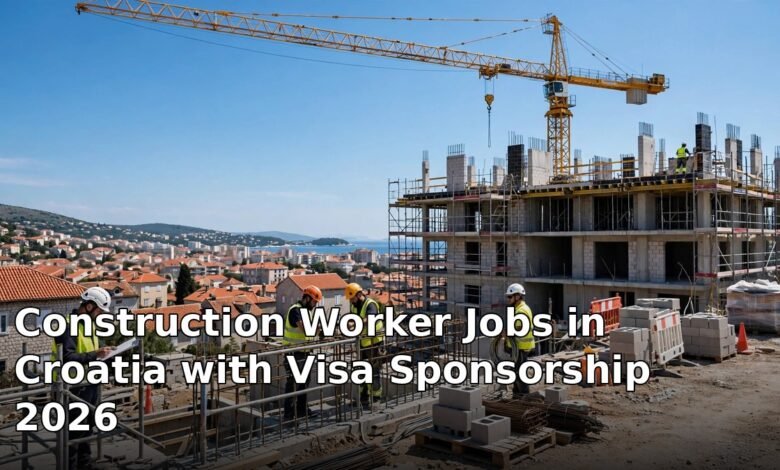
Construction worker jobs in Croatia with visa sponsorship 2026 sit at the centre of one of Europe’s clearest labour shortages. With young Croatians moving west for higher wages, employers in Zagreb, Split, Rijeka, Osijek and Zadar are building housing, hotels, roads and railways with too few hands — and construction is consistently named on Croatia’s official shortage occupations list. The daily work is what you would expect: site preparation and cleanup, carrying and moving materials, assisting bricklayers, carpenters and steel-fixers, mixing and pouring concrete, basic formwork, and operating hand and power tools under a site supervisor’s direction. An honest note on pay: Croatia’s reported 2026 minimum wage floor is €1,050 gross per month, but construction wages are set by collective agreements and vary by trade and experience — confirm the exact figure in the written contract before you travel, never trust a verbal promise. The demand is real and the route below is designed for exactly this hiring, but everything flows through the employer — which is where the next section matters.
The Real Route: Croatia’s Employer-Led Stay-and-Work Permit
The real route is Croatia’s combined temporary residence and work permit (dozvola za boravak i rad) — one permit, issued by the local police administration of the Ministry of the Interior (MUP), covering both stay and work for up to 12 months, renewable. The mechanics are employer-driven and non-negotiable: you secure a job offer, the employer applies for the permit on your behalf (via the HZZ e-Radna dozvola platform or directly to MUP), the permit is approved, and then you apply for the Type D long-stay visa at the Croatian embassy in your country before travelling. Where the shortage list changes the game: Croatia abolished its annual foreign-worker quota in 2021 and replaced it with a labour market test — the employer must get an HZZ opinion confirming no suitable Croatian or EU worker is available — but occupations on the official shortage list, which includes construction trades, skip or fast-track that test. This is the single biggest reason construction is Croatia’s most accessible sponsored sector: the bureaucracy is lightest exactly where the demand is highest.
For the full permit mechanics, read our Croatia work visa process guide — it maps how the combined stay-and-work permit works.
See jobs in Croatia with visa sponsorship for foreigners for the wider picture of sponsored sectors.
For shorter stints, check the Croatia seasonal work permit guide — the up-to-six-months route.
Or compare the trade in construction worker jobs in Germany with visa sponsorship.
The 2026 Employer Rules You Need to Know (April 2026 Ordinance)
Read this section twice, because 2026 changed the employer side of the equation. A new ordinance in force from 30 April 2026 sets strict financial conditions for any employer applying for foreign-worker permits: legal entities must show at least €100,000 of turnover in the last 12 months (craftsmen €40,000), the business account must not have been blocked for more than 30 days continuously in the last 6 months, and the employer must already employ at least one Croatian/EEA worker full-time on an indefinite contract for at least a year. On top of that, new mandatory domestic-worker ratios apply: at least 10% domestic employees for shortage-list occupations (20% where a labour market test is run). What this means for you is practical: fly-by-night subcontractors can no longer sponsor permits the way they once did, so the pool of sponsoring construction companies is now genuinely filtered for financial health. Treat that as protection, not an obstacle — a company that passes these checks is far less likely to vanish with your wages. On timing, the 2026 law lets MUP take up to 90 days plus a possible 30-day extension, so realistic timelines run 8-12 weeks from job offer to arrival.
Employer-Tied Permits: The Honest Warnings
Two honesty points decide whether this route works for you. First, you cannot self-sponsor — there is no job-seeker permit that lets you arrive and look for construction work, and no application you can file yourself. The employer initiates everything, and the permit stays tied to that employer and role throughout its life. Second, verify the employer’s registration before paying anyone anything: the standard scam in this market is an ‘agent’ collecting fees for a permit that only the employer can apply for, with companies that fail the new financial thresholds. Legitimate employers recruit through Croatia’s national portals (infostud, moj-posao), the HZZ listings and licensed recruiters — never through WhatsApp fee requests. One more 2026 rule to plan for: a basic Croatian language requirement (A1.1 level) applies at your first permit renewal, so language study is not optional for anyone staying beyond year one. Accommodation is often arranged by construction employers, but get the housing terms in writing before travel.
How to Apply for Construction Worker Jobs in Croatia with Visa Sponsorship 2026
Construction worker jobs in Croatia with visa sponsorship 2026 are won by applying where Croatian construction employers actually advertise: the national job portals infostud and moj-posao, the Croatian Employment Service (HZZ) listings, LinkedIn, and the career pages of established construction firms (international firms like STRABAG operate Croatian subsidiaries hiring on local projects). Prepare a CV focused on site experience, trades and physical roles; state your visa situation plainly — employers familiar with the shortage-list route run these recruitments routinely. Expect the document set to include your passport, signed employment contract, proof of qualifications or trade experience, criminal record certificate, accommodation proof and health insurance, and attend the Type D visa interview at the Croatian embassy after the permit is approved. One transparency note: no current individual construction listing could be verified at write time, so no Apply Now link is published here rather than an unverified one — search the portals above for live postings and confirm with the employer that the role sits on the current shortage list before you rely on it.
Frequently Asked Questions
Is there a work-permit quota for Croatia in 2026?
No. Croatia abolished its foreign-worker quota system on 1 January 2021. Employers now request a labour market test from the Croatian Employment Service (HZZ) — but roles on the official shortage list, including construction, are exempt or fast-tracked, which is what makes construction one of the easiest sectors to sponsor.
Can I change employers once I have a Croatian work permit?
No — the permit is tied to the named employer and role. Changing jobs means a new permit application with the new employer. This is why the employer you choose matters so much: verify the company’s registration and financial standing before you travel, because you cannot simply walk onto another site.
Do I need to speak Croatian to work construction in Croatia?
Not to enter, but the 2026 rules introduced an A1.1 Croatian language requirement at your first permit renewal (around June 2027). On the construction site itself, basic Croatian is genuinely useful — safety instructions and supervisors work in Croatian. Start learning from day one rather than at renewal time.
How long does the Croatian work permit process take?
The 2026 law allows the Ministry of the Interior up to 90 days for a decision, with a possible 30-day extension. Realistic timelines reported by recruitment professionals run 8-12 weeks from confirmed requirement to arrival, including the HZZ labour market step and the Type D long-stay visa at the Croatian embassy. Budget months, never days.
Construction worker jobs in Croatia with visa sponsorship 2026 are a genuine employer-led route: Croatia’s construction sector sits on the official shortage list, the quota system was abolished in 2021, and the combined stay-and-work permit is designed for exactly this kind of hiring. The honest side is equally clear — the permit is tied to the employer, the employer must pass 2026’s financial and staffing checks, you cannot self-apply, and processing takes months. Target real Croatian construction employers, verify their registration before paying anyone a cent, and apply through Croatia’s national job portals rather than anyone promising a fast track.