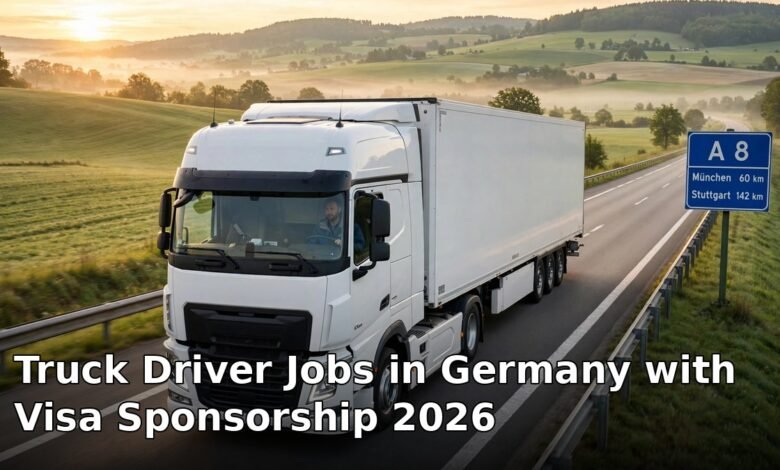
Truck driver jobs in Germany with visa sponsorship 2026 are genuinely available: the Skilled Immigration Act covers professional drivers (Berufskraftfahrer), and logistics employers are hiring — a live MAX STREICHER listing in Rosenheim offers a permanent contract on a 4-day week. But there is no shortcut: you need an EU-recognised CE licence with Code 95 and A2/B1 German. Here is the real route, the pay, and how to apply.
Considering Germany more broadly? Our Germany Opportunity Card guide explains the points-based alternative for job seekers.
The Real Route: Berufskraftfahrer Under the Skilled Immigration Act
Germany’s Skilled Immigration Act explicitly covers professional drivers. As a Berufskraftfahrer with a recognised qualification, you count as a skilled worker (Fachkraft) — which means an employer can sponsor your visa without the labour-market priority checks that apply to unskilled roles. The three gates are non-negotiable: (1) your CE truck licence must be recognised in Germany, including Code 95 professional competence; (2) you need German at A2/B1 level — employers and the visa process both require it, and there is no realistic no-German route; (3) a concrete job offer from a German logistics employer. Meet those three and the route is written law, not luck.
Live Example: LKW-Fahrer Listing in Rosenheim
A live example from the official Make it in Germany portal: MAX STREICHER GmbH & Co. KGaA seeks an LKW-Fahrer (m/w/d) in Rosenheim, Bavaria — full-time, permanent contract, 4-day week (Monday to Thursday), handling internal and external construction-site transport. Requirements are typical: CE licence, truck-driving experience, reliability and flexibility. Listings across Germany echo the same pattern — container transport in Bochum wants CE with Module 95 and 1+ years’ experience; mineral-oil logistics firms offer €1,000–€2,000 starting bonuses for CE drivers with ADR. The demand is structural, not seasonal.
Related German routes: driver jobs in Germany with visa sponsorship and Germany needs drivers on work visas. For the visa framework, see Germany’s Opportunity Card guide.
Licence Recognition: The Step You Must Not Skip
Non-EU driving licences are not automatically valid for professional driving in Germany. Depending on your country, you may need to convert your licence — some states recognise certain foreign licences partially, but most non-EU drivers must complete additional training and pass German theory and practical tests, plus the Code 95 modules. Start this process before you apply: contact the Fahrerlaubnisbehörde or a Fahrschule that handles Berufskraftfahrer recognition, and get a written statement of what your licence needs. Employers take you seriously once recognition is underway.
How to Apply for Sponsored Truck Driver Roles
Target mid-size and large logistics employers — names like STREICHER, mineral-oil and container transport firms — that advertise on the Make it in Germany portal and have sponsored before. Learn German to B1 before you apply; it is the single biggest filter. Prepare your licence documents, Code 95 proof, employment references and a clean driving record. Apply in German (or bilingual) directly to the employer, and never pay a recruiter for the placement — German law puts sponsorship costs on the employer, not you.
Apply Now
Employer: MAX STREICHER GmbH & Co. KGaA – Rosenheim (via Make it in Germany)
Frequently Asked Questions
Can Germany sponsor foreign truck drivers?
Yes, through the Skilled Immigration Act (Fachkräfteeinwanderungsgesetz). Professional drivers (Berufskraftfahrer) are recognised skilled workers: with a recognised foreign CE licence (plus Code 95), A2/B1 German and a concrete job offer, an employer can sponsor your work visa and residence permit.
What licence do I need to drive trucks in Germany?
You need an EU-recognised CE driving licence with Code 95 (driver qualification card), at least basic German (A2/B1 is typically required), and usually 1+ years of driving experience. Non-EU licences must go through recognition — some countries have partial recognition agreements, others require additional training or tests.
How much do truck drivers earn in Germany?
Professional drivers in Germany typically earn €35,000 to €45,000 a year, with long-haul and ADR (dangerous goods) specialists higher. The MAX STREICHER role offers a 4-day week (Monday–Thursday) and a permanent contract, which is increasingly common as employers compete for drivers.
How does the sponsorship process work?
The employer must offer you a concrete job and support the visa process; you apply for the work visa at the German embassy in your country. EU citizens need no visa at all — this route is for non-EU drivers. Never pay an agent for the job itself; legitimate German logistics employers recruit directly and cover sponsorship costs.
Truck driver jobs in Germany with visa sponsorship 2026 are real, but they are not a shortcut: the Berufskraftfahrer route demands a recognised CE licence with Code 95, A2/B1 German, and an employer willing to navigate the Skilled Immigration Act with you. The MAX STREICHER listing shows the demand is genuine — 4-day weeks and permanent contracts exist. Learn the language, get your licence recognised, and target logistics employers with sponsorship experience.