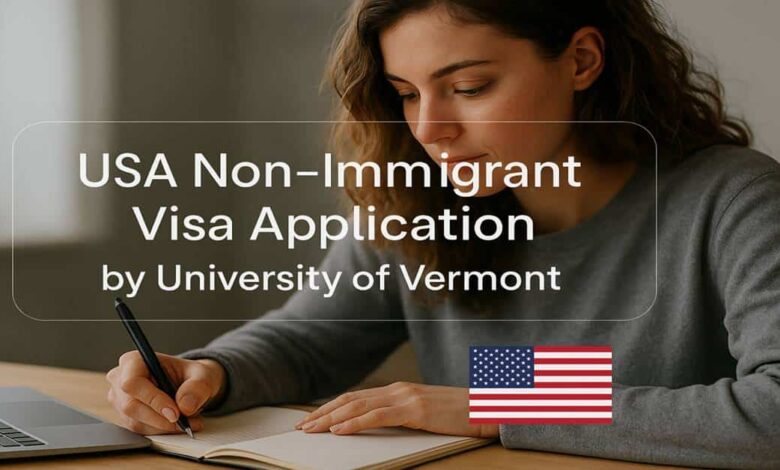
The University of Vermont’s Office of International Education (OIE) walks incoming scholars and staff through the US non-immigrant visa process, covering H-1B, J-1, TN, and E-3 categories. The standard path runs through supporting documents from OIE, the online DS-160 application, the visa fee payment, and a consular interview.
For a broader look at US temporary work routes, read our guide to the 2-year temporary work permit in the USA and its application steps.
Steps to Apply for US Visa:
If you are seeking US employment sponsorship, see how to get an American work visa through the Department of Labor for the official labor-certification path.
The University of Vermont (UVM) has provided overseas applicants with the following 5 streamlined stages to apply for a U.S. visa in 2026; these procedures apply to visa types such as H-1B, J-1, TN, and E-3:
Step 1: Receive Supporting Documents from UVM’s Office of International Education (OIE)
Depending on your visa type, you’ll receive one of the following documents from OIE:
- H-1B Visa:
- I-797 Approval Notice (issued after USCIS approval)
- J-1 Scholars:
- DS-2019 Form (issued via UVM’s iStart system)
- TN-2 Visa (for Canadian or Mexican professionals):
- A letter confirming your proposed employment from UVM
- E-3 Visa (for Australian citizens):
- An employment offer letter
- A Certified Labor Condition Application (LCA)
Tip: Examine all documents carefully as soon as you receive them. Please get in touch with OIE right away to request revisions if you discover any mistakes or missing information.
Complete Form DS-160 (Online Visa Application)
The DS-160 Nonimmigrant Visa Application must be filled out honestly and completely by applicants. A thorough personal and professional history will be requested on the questionnaire, including:
- Immigration history, past addresses
- Education background
- Social media handles (past 5 years)
Pay the Visa Fee: You must pay the normal DS-160 charge online after submitting. There may be extra issuance fees in some nations. It is required for the interview that you keep your receipt.
Read Also: 2 Year Temporary Work Permit in USA
Schedule and Prepare for Visa Interview:
After completing the Online Nonimmigrant Visa Application (DS-160), schedule your visa interview at the closest U.S. embassy or consulate by following the confirmation instructions.
Then, prepare the required documents based on your visa type:
H-1B Visa Applicants
You’ll need to bring:
- DS-160 confirmation page & Visa fee receipt
- Valid passport
- Original I-797 approval notice + Full copy of the H-1B petition
- Educational credentials (Degrees, transcripts)
- Resume/CV
- If employed: Recent pay stubs or employment confirmation from UVM
J-1 Scholars
Make sure you have
- DS-160 confirmation page & SEVIS I-901 fee receipt
- Passport + DS-2019 form
- Proof of funding & Invitation/Offer letter from UVM
- Optional: Proof of ties to your home country (helps demonstrate intent to return)
TN Visa (for Mexican Citizens)
Prepare the following:
- DS-160 confirmation + Visa fee receipt
- Passport + Academic credentials
- UVM employment confirmation letter
- Optional: Proof of ties to your home country
- Credential evaluation (if your degree is from outside the U.S./Canada/Mexico)
Pro Tip: Each U.S. embassy or consulate may have different criteria for visa documents. To find out about any additional or nation-specific document requirements, always visit the official website of the U.S. consulate in your area.
Attend Your Visa Interview:
Here is Step 4 of the U.S. visa application process for 2026:
The most important phase in your visa application process is this one. Here’s what to anticipate and how to get ready:
Interview Conduct
- Speak with assurance and clarity because this is a one-on-one interview and no representatives or translators are permitted.
- Effective communication of your goals and plans is essential.
Top Interview Tips
- Keep it short and focused
Avoid giving lengthy or ambiguous explanations, as they may lead to misunderstandings. - Be honest and polite
Honesty and consistency are essential. Denial may result from lying or evasive behavior. - Connect your goals with your UVM opportunity
Describe how your research, program, or position advances your academic or career goals. - Ask for clarification if needed
It’s okay to politely say, “Could you please repeat or rephrase that question?”
Bonus Tip: Even if they are not specifically needed, bringing additional materials demonstrates your readiness. Dress properly and carry all of your supporting documentation.
Wait for Visa Issuance and Passport Return:
Waiting for a decision and the return of your passport together with the visa is the next stage after your interview.
Track Your Application
The U.S. Department of State’s Visa Status Check page allows you to keep track of your visa status, while the Visa Appointment Wait Times page provides basic processing dates.
Visa Appointment & Processing Times
Processing Time:
- Although processing times can vary, most applicants receive a judgment in a matter of days.
- Administrative Processing: Additional scrutiny may be necessary in certain situations, which could cause a delay in issuing. During the interview, you will be told if your case is being processed administratively.
Passport Return
Depending on the policies of the local consulate, your passport (together with the visa) will either be returned by courier or made available for pickup.
References:
Conclusion:
Applying for a U.S. visa through UVM involves five clear steps: receive supporting documents, complete the DS-160, pay fees, attend your interview, and track your visa. Careful preparation and honest, clear communication are key to a smooth process. With patience and focus, you can successfully secure your visa and start your U.S. academic or professional journey.
Documents Required for Your US Visa Interview
Confused about immigrant versus non-immigrant status? Our explainer on the differences between a green card and a US visa clears up the key distinctions.
Which US visa types does the University of Vermont support?
UVM’s Office of International Education supports H-1B work visas, J-1 exchange scholar visas, TN visas for Canadian and Mexican professionals, and E-3 visas for Australian citizens. Each category has its own supporting document, such as the I-797 approval notice or the DS-2019 form.
What is the DS-160 form in the US visa process?
The DS-160 is the online non-immigrant visa application every applicant must complete. It collects personal history, education, work, immigration, and social media details. You must submit it honestly and bring the confirmation page to your interview. Answer every section honestly and completely, since inconsistencies in your responses can cause delays or a refusal at the interview stage.
What documents should I bring to a US visa interview?
Bring your passport, DS-160 confirmation page, visa fee receipt, and the supporting document for your category, such as the I-797, DS-2019, or employment letter. Educational credentials, a resume, and proof of funding or ties to your home country also help.
Do I pay a visa fee when applying for a US non-immigrant visa?
Yes. After submitting the DS-160, applicants pay the standard visa application fee online, plus any country-specific issuance fees and the SEVIS fee where applicable. Keep all receipts, since you need them for the consular interview. Keep every receipt safe, because you must present them to the consular officer as proof of payment during your visa interview.
Travelers may also want to check whether they qualify for visa-free travel under USA VWP adds more eligible countries 2026.
Finally, review US temporary work visas with qualifying occupations to find which visa category matches your profession.