Canada’s restaurants, hotels and catering companies are hiring kitchen helpers again in 2026, and many employers are willing to sponsor foreign workers through the Labour Market Impact Assessment (LMIA) route. Kitchen helper jobs in Canada with visa sponsorship 2026 are among the most accessible work-abroad options: no degree is required, English requirements are basic, and full-time positions typically pay CAD $16 to $20 per hour.
This guide explains what kitchen helpers do, realistic 2026 salary ranges by province, how LMIA sponsorship works, the documents you need, and the exact steps to apply safely. If you are new to the Canada work permit process, start with our step-by-step guide to understand how employer-sponsored permits are issued.
What Does a Kitchen Helper Do in Canada?
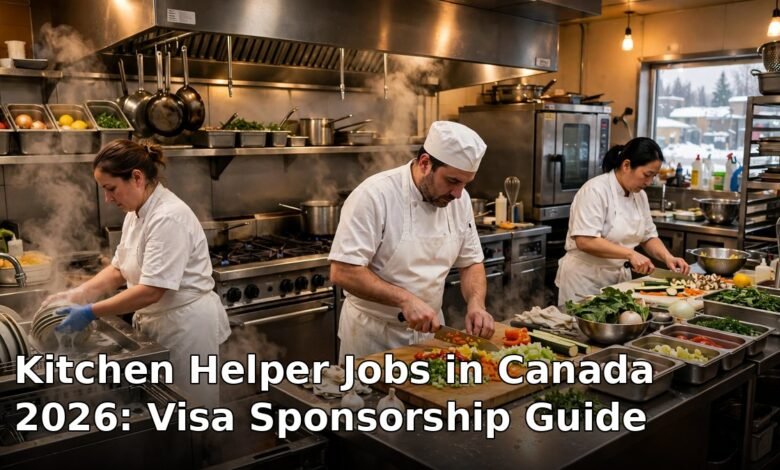
Kitchen helpers are the backbone of every commercial kitchen in Canada. The role covers food preparation support, dishwashing, cleaning work areas and equipment, receiving and storing supplies, portioning and wrapping food, and helping cooks and chefs during busy service hours.
Most openings are advertised by restaurants, hotel kitchens, catering companies, food production plants, daycare centres and remote work camps. Hours are usually full-time (30–44 hours per week) on rotating shifts that include mornings, evenings and weekends. Training is normally provided on the job, so previous kitchen experience is an advantage but rarely a requirement.
Officially, the occupation is classified at a low skill level (TEER 5), which is why the entry barrier is so low — employers prioritise reliability, stamina and a positive attitude over formal qualifications. Note the distinction: a cook is classified at TEER 3 and has stronger pathways to permanent residence, while a kitchen helper’s PR options are narrower — something we cover in the FAQs below.
Kitchen Helper Salary in Canada in 2026
Kitchen helper wages must meet or exceed the prevailing wage for the occupation in the employer’s region — an LMIA will not be approved below it. Typical advertised rates in 2026 are:
- Ontario: CAD $15–$20 per hour
- British Columbia: CAD $16–$20 per hour
- Alberta: CAD $15–$19 per hour
- Quebec: CAD $14–$18 per hour
- Manitoba: CAD $14–$17 per hour
At full-time hours, that works out to roughly CAD $2,000–$3,500 per month before tax. Many employers add free or subsidised meals, overtime pay and seasonal completion bonuses. Remote camp kitchens serving mining, forestry and energy operations often pay well above city rates and include accommodation and meals — judge these offers on the wage after accommodation, not just the headline rate.
Large cities like Toronto and Vancouver pay more, but housing costs eat into the difference; smaller towns and rural employers sometimes offer easier hiring and, in the low-wage stream, the employer must also cover your round-trip transportation and help arrange affordable housing.
Kitchen work is one route into Canada, but if you have hands-on trade skills, our Federal Skilled Trades Program guide explains a separate permanent-residence pathway worth comparing.
Exploring more than one occupation? See how sponsored truck driver work visas work across the US, UK, Canada and Australia — another field where foreign workers are in steady demand.
How Visa Sponsorship Works: LMIA and the Temporary Foreign Worker Program
“Visa sponsorship” for kitchen helper jobs runs through Canada’s Temporary Foreign Worker Program (TFWP). The process has three stages. First, the Canadian employer applies to Employment and Social Development Canada for a Labour Market Impact Assessment (LMIA) — a document proving no qualified Canadian was available for the job. Second, with a positive LMIA, the employer issues you a formal job offer. Third, you apply for an employer-specific work permit using the LMIA and the offer letter.
Crucial facts to know: the employer pays the LMIA processing fee and cannot legally pass it on to you; in the low-wage stream the employer must also pay for your round-trip transportation and assist with affordable housing. You pay your own work permit fee, biometrics, medical exam, police certificates and travel. And a genuine offer will never ask you to pay for the job itself — charging workers for placement is unlawful in most Canadian provinces.
Not every kitchen helper ad includes sponsorship — only apply to listings that explicitly mention an approved or pending LMIA, and confirm the LMIA details with the employer before you spend money on an application.
Eligibility and Documents You Will Need
The entry bar is deliberately low, which is what makes these roles popular. Most sponsoring employers ask for:
- Minimum age of 18 and a valid passport
- Basic English communication skills (IELTS is not required by most employers)
- Physical ability to stand for long shifts and lift supplies
- A clean criminal record
- Willingness to work shifts, evenings and weekends
- Often a secondary (high) school certificate — some ads ask for 7–12 months of related experience, many provide training instead
For the work permit application itself, Immigration, Refugees and Citizenship Canada typically requires: the job offer letter, the positive LMIA (or proof of exemption), a Canadian-format resume, police clearance certificates from every country where you have lived six months or more since age 18, an immigration medical exam from a panel physician, the completed work permit forms, recent passport photos and proof of funds for your arrival.
How to Apply for Kitchen Helper Jobs With LMIA Sponsorship
Follow these steps in order:
- Step 1 — Search the right listings. Use Canada’s official Job Bank and filter for postings that state “LMIA approved” or “authorised to hire foreign workers”. Legitimate ads name the employer, wage, hours and location.
- Step 2 — Prepare a Canadian-style resume. Keep it to two pages, list duties and dates clearly, and include references with contact details.
- Step 3 — Apply directly to the employer. Most LMIA ads accept applications by email. Write a short cover note, attach your resume, and mention your availability and English level honestly.
- Step 4 — Verify the offer. Ask for the LMIA approval details in writing. Never pay an “agent fee” for the job, and check the employer exists at the listed address.
- Step 5 — Apply for the work permit. Once you hold the signed offer and the LMIA, submit your work permit application with your documents and biometrics.
Competition is real, so apply to multiple employers across provinces — smaller cities and rural towns often respond faster than Toronto or Vancouver kitchens.
Apply Now
Employer: LAVAZIO LTD — Edmonton, Alberta
Apply Now: LAVAZIO LTD in Edmonton, Alberta is hiring 2 kitchen helpers at CAD $16.00 per hour for 35 hours per week, permanent full-time, with an approved LMIA — meaning the employer is authorised to hire foreign workers. Training is provided and only a secondary school certificate plus basic English are required. See the full listing (listed via Canada Job Bank) and apply by email with your resume.
Frequently Asked Questions
Do I need experience or a degree to get a kitchen helper job in Canada with visa sponsorship?
No. Kitchen helper is a TEER 5 occupation with no degree requirement, and most sponsoring employers provide on-the-job training. Basic English, physical fitness, a clean record and a valid passport matter far more than qualifications. Some ads ask for a secondary school certificate or a few months of related experience, but many hire complete beginners.
How much do kitchen helpers earn in Canada in 2026?
Most advertised roles pay CAD $16 to $20 per hour, with provincial ranges from about $14 in Manitoba and Quebec to $20 in Ontario and British Columbia. Full-time workers typically take home roughly CAD $2,000–$3,500 per month before tax, plus perks like free meals and overtime. Remote camp kitchens often pay above these rates and include accommodation and meals.
What is an LMIA and how does it lead to a Canadian work permit?
An LMIA (Labour Market Impact Assessment) is a document a Canadian employer obtains to prove no qualified Canadian was available for the role. With a positive LMIA and a signed job offer, you can apply for an employer-specific work permit under the Temporary Foreign Worker Program. The employer pays the LMIA fee and cannot charge it to you; you cover your own permit fee, medical exam, biometrics and travel.
Can a kitchen helper job lead to permanent residence in Canada?
It is harder than for higher-skilled roles. Kitchen helper sits at TEER 5, so it does not qualify for the Canadian Experience Class the way a cook (TEER 3) does after one year of Canadian work. Realistic PR routes include provincial nominee streams for semi-skilled workers, the Atlantic Immigration Program and the Rural Community Immigration Pilot (RCIP). Treat the job as a strong first step, and research your province’s nominee options early.
Kitchen helper jobs remain one of the simplest LMIA-backed routes into Canada in 2026 — low entry barriers, steady full-time hours and real sponsoring employers across every province. Start with LMIA-approved listings on Job Bank, apply to several employers, verify every offer in writing, and never pay anyone for a placement. Your Canadian kitchen career can begin with a single well-prepared application — good luck!