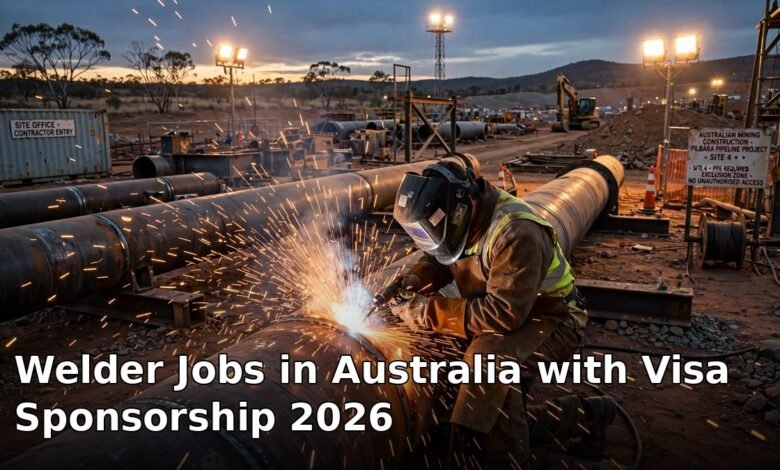
Welder jobs in Australia with visa sponsorship 2026 run on one of the strongest skilled-trade routes in the country: Welder (First Class) sits on the Core Skills Occupation List, unlocking the 482 Skills in Demand visa and the permanent 186 visa. Live SEEK listings show Pilbara shutdowns paying $76.15 an hour and Karratha LNG projects paying $6,270–$6,600 a week on FIFO rosters. Here are the real requirements, the pay, and how to apply.
If the 482 sounds right for you, our Australia Skills in Demand visa guide walks through the sponsorship process step by step.
The Real Route: 482 and 186 Visas for Welders
This is a real route, not a grey area. Welder (First Class), ANZSCO 322313, sits on the Core Skills Occupation List, which unlocks employer sponsorship under the Skills in Demand visa (subclass 482) and the permanent Employer Nomination Scheme (subclass 186). Mining, LNG, construction and fabrication employers across Western Australia, Queensland and New South Wales sponsor welders every year — SEEK currently lists hundreds of 482-tagged welder roles. The employer must be an approved sponsor, the job must pay at or above the market rate, and you must clear a skills assessment.
Live Market: What WA Employers Are Paying in 2026
Live SEEK listings show the market clearly. Pilbara shutdowns seek boilermaker/welders at $76.15 an hour with weld testing; Project Ceres in Karratha hires special-class FCAW welders at $6,270–$6,600 gross per week on a 2:1 FIFO roster for 2+ year projects; pressure welders for power-station shutdowns command $83.70 an hour flat plus accommodation and meal allowances. These are 482-tagged, employer-sponsored roles — the real pipeline, not a promise. FIFO rosters (2:1, 8:6, 7:7) dominate WA, with flights from Perth and strong overtime.
Explore related Australian trades: boilermaker and welder jobs in Australia and painter and decorator jobs in Australia with visa. For the visa mechanics, see Australia’s work permit application process and Australia’s Skills in Demand visa pathway.
Tickets, Skills Assessment and What Employers Check
Sponsored roles expect coded welding tickets (6G and similar), proven structural, pipe or pressure-welding experience, and the ability to pass employer weld tests. For the visa, most welders need a formal skills assessment plus English at the threshold level. If your tickets are from outside Australia, get them mapped against Australian standards early and keep detailed employment references — assessors want proof of hours and scope, not just certificates. White card (construction induction) is also standard on Australian sites.
How to Apply for Sponsored Welder Roles
Apply directly to the employer’s SEEK listing — never pay a migration agent a placement fee for the job itself. Shortlist 482-tagged roles matching your welding codes, prepare a CV that names your tickets, processes (MIG, TIG, FCAW, stick) and project history, and attach reference letters. Ask the employer to confirm in writing that they are an approved 482 sponsor before you resign anything at home. If an offer looks real, a registered migration agent can handle the visa paperwork — but the job offer must come first, from the employer.
Apply Now
Employer: Multiple WA employers – Pilbara/Karratha (via SEEK)
Frequently Asked Questions
Is welding on Australia’s skilled occupation list?
Yes. Welder (First Class), ANZSCO 322313, is on the Core Skills Occupation List, which makes it eligible for employer-sponsored visas including the Skills in Demand visa (subclass 482) and the Employer Nomination Scheme (subclass 186). The employer must be an approved sponsor and the role must meet salary and labour-market requirements.
How much do sponsored welders earn in Australia?
FIFO welders in Western Australia earn strong money: shutdown roles advertise around $76.15 an hour, special-class coded welders on major LNG and construction projects earn $6,270–$6,600 gross per week on 2:1 rosters, and experienced welders can clear AUD $150,000–$190,000 a year with overtime. Typical sponsored welder salaries sit in the AUD $80,000–$100,000 range.
What qualifications do I need as a foreign welder?
Most sponsored welding roles ask for coded welding qualifications (e.g. 6G), several years of structural or pipe welding experience, and the ability to pass weld tests. For the visa itself, a formal skills assessment through the relevant assessing authority is usually required, plus English at the required level. Start the skills assessment early — it is often the slowest step.
What is the difference between the 482 and 186 visas for welders?
The 482 Skills in Demand visa is temporary (up to 4 years) and ties you to the sponsoring employer, but it can lead to permanent residency through the 186 visa. The 186 Employer Nomination Scheme grants permanent residency directly but has stricter requirements. Many welders enter on 482 and transition to 186 after two to three years with the same employer.
Welder jobs in Australia with visa sponsorship 2026 are among the most genuine skilled-trade routes going: the occupation sits on the Core Skills Occupation List, employers across the Pilbara are hiring on 482 visas right now, and FIFO packages can clear AUD $150,000 a year. The bar is real too — coded welding tickets, a skills assessment and solid experience. If you hold those, this is one of the strongest sponsorship plays in the Australian trades.